High-Converting Video Testimonials for Faster Growth
Learn how to create a high-converting video testimonial that builds trust, boosts conversions, and turns client stories into silent sales assets.
Most businesses treat testimonials like decoration.
A quote at the bottom of a page.
A logo strip no one reads.
A “nice to have” that never moves the needle.
But when prospects see real customers tell real stories on video, something changes. Trust forms faster. Pages hold attention longer. Conversions happen with far less convincing.
In a market where people believe peers more than polished ads, high-converting video testimonials aren’t fluff—they’re a growth asset. And when they’re done right, a handful can outperform entire campaigns.
Key Takeaways
A high-converting video testimonial can increase conversions and lift trust by showing real faces, voices, and emotions instead of static text reviews.
The core conversion formula for powerful testimonials is Clear Outcome + Credible Person + Specific Context + Emotional Journey + Soft Recommendation.
Design each customer story to climb the trust stack and micro-belief chain, making the viewer think, “This person is like me, got my result, and it feels safe to act now.”
Edit for performance, not polish: keep videos under 2 minutes, lead with the strongest result in the first few seconds, and preserve human imperfections that prove authenticity.
Use different styles of high-converting video testimonial: outcome-specific, pain-to-transformation, risk reversal, and quick 20-second BOFU clips—strategically across pricing pages, proposals, landing pages, and ads to move prospects to action.
Why High-Converting Video Testimonials Outperform Every Other Proof Asset
You’ve probably got some proof already: Google reviews, a case study PDF, maybe a few LinkedIn comments.
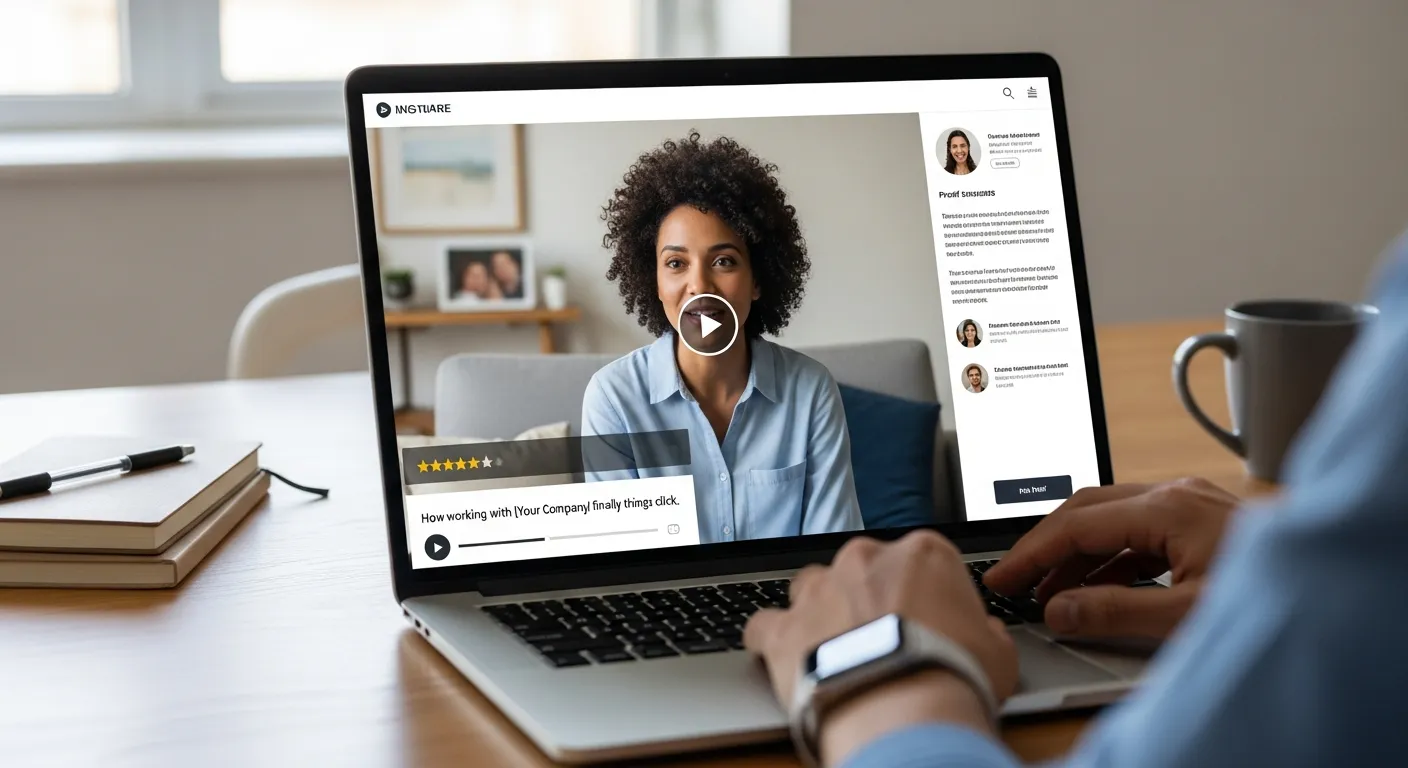
But nothing hits quite like looking a happy client in the eyes, seeing their micro-smile when they talk about the moment things finally clicked after working with you.
That’s what a high-converting customer video does on your site.
A few reasons it outperforms everything else:
People remember faces and voices better than text.
Emotion + story beats a static 5‑star graphic every single day.
Watching a real person talk about your service quietly answers the question stuck in your buyer’s head: “Will this work for me?”
64% of viewers say they are more likely to purchase a product after watching a video testimonial. On top of that, those clips keep people on your pages longer, bumping up dwell time, a ranking signal Google cares about.
If you’re in healthcare, finance, or real estate, this matters even more. You’re asking people to trust you with their health, money, or home, deeply personal stuff. A written quote like “They were great” just doesn’t carry the same weight as a calm patient talking about how you held their hand through a scary diagnosis, or a first‑time buyer grinning about closing on a house they thought they’d never get.
Plain text builds awareness.
A high-converting customer story on camera builds belief.
The Conversion Formula Behind High-Converting Testimonials
Let’s make this practical.
When you strip the fancy cameras and lighting away, every powerful testimonial comes down to a simple conversion formula:
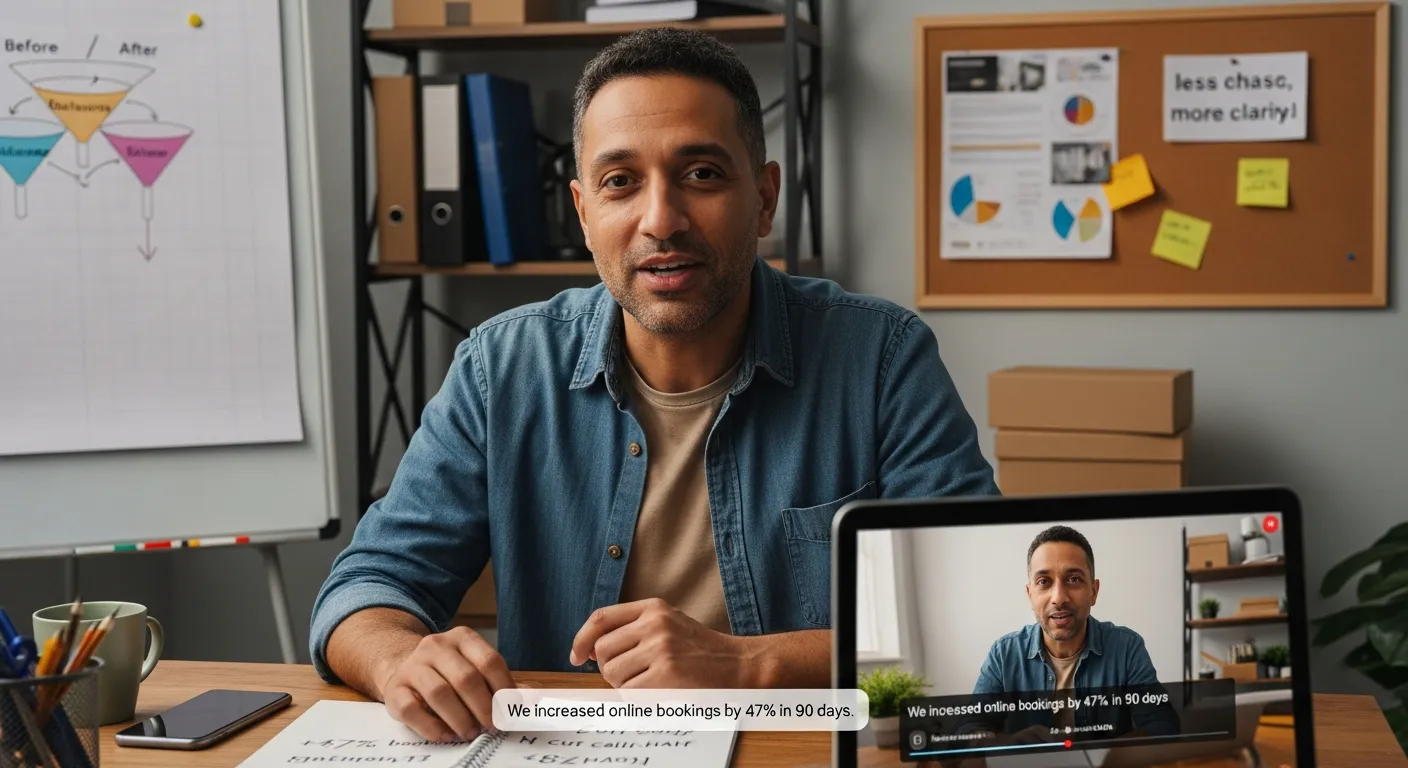
Clear Outcome + Credible Person + Specific Context + Emotional Journey + Soft Recommendation
If those five ingredients are there, you’re in business.
The Trust Stack
Trust doesn’t show up all at once. Your viewer climbs it like a ladder:
Relevance – “This person is like me.” Same kind of business, same stage of life, same worries.
Credibility – “They’re real, and they used this.” Name, role, and how long they’ve worked with you.
Specificity – “I can see exactly what changed.” Numbers, timeframes, concrete details.
Believability – “This doesn’t sound like an ad.” Normal language, little imperfections, no corporate script.
If you skip a rung, say you show a super polished video with zero specifics, your “trust stack” cracks. The viewer might enjoy the video but still think, “Cool… but I’m not sure it would work for me.”
The Micro-Belief Chain
Inside your buyer’s head, there’s a tiny checklist firing while they watch. A strong testimonial quietly checks each box:
“People like me use this.” Same industry, similar problem size.
“This fixes the exact headache I have.” Not generic “better results,” but “closed three more deals a month” or “cut call volume in half.”
“This outcome applies to me.” They see the before/after and can picture the shift.
“I trust the person speaking.” They look relaxed, their story flows, they’re not reading.
“It feels safe to act now.” They hear something about support, clarity, or low risk.
Your job is to design the story so those beliefs line up in order.
What High-Converting Testimonials Share
Across industries, the best converting stories always seem to have the same DNA:
You can see emotion on the person’s face, relief, excitement, and a little pride.
There’s at least one clear outcome: “We increased online bookings by 47%,” “We shaved 3 weeks off our closing timeline,” “Collections improved in 90 days.”
The transformation is specific: anxious → confident, chaotic pipeline → predictable revenue, no-shows → fully booked calendar.
The delivery feels low-friction and human: natural pauses, real language, no brand robot voice.
There are tiny imperfections: a half‑laugh, a “let me think,” a glance off camera, which raise trust.
If your current testimonials feel flat, it’s almost always because one of those pieces is missing, not because you “just need better gear.” Stop guessing how to start your customer stories and instead use a structured testimonial hook library to lead with the most compelling emotional or data-driven results.
Emotional Drivers: The Emotional Stack Framework
You’re not just capturing words: you’re capturing a journey.
A high-converting story often moves through five emotional beats. Picture them like stepping stones your viewer walks across.
1. Identification Emotion
First, your prospect thinks, “That’s me.”
For a private practice therapist, that might be a client saying, “I was juggling 60‑hour weeks and still chasing payments.” For a financial planner, it’s a client joking, “I had 14 accounts and zero clue what was going on.”
Accents, background, clothes, even the Zoom backdrop, all of it signals, “this person lives in my world.” That identification moment is where your viewer leans in.
Practical tip: choose clients who mirror your ideal audience: similar age range, industry, and energy level.
2. Pain Recognition Emotion
Next comes the quiet gut punch:
“They get my problem.”
You want your client to describe the before state in their own words:
“We were losing leads because no one trusted our tiny clinic.”
“I felt sick every time I opened my bank app.”
“We kept hearing, ‘We went with a bigger firm instead.'”
When your viewer hears their private worries spoken out loud, they feel seen, and that’s addictively persuasive.
3. Relief Emotion
Then you want a shift.
Look for the moment their shoulders drop a bit in the recording, or they smile when they say, “Honestly, I slept through the night the first week we switched over.”
These little micro-smiles, sighs, and softer tones are relief on camera.
It’s the emotional version of opening a window in a stuffy room; your viewer feels it in their body, even if they can’t explain why.
4. Proof Emotion
Relief is nice. Proof is what sells.
This is where they get concrete:
“Our closing rate went from 18% to 31% in three months.”
“No-show appointments dropped by half.”
“We added $40k in commission in one quarter without more ad spend.”
When they say that on camera with calm certainty, your viewer feels an internal click; that’s proof of emotion. The brain goes from “Maybe” to “Oh, this is real.”
5. Aspiration Emotion
Finally, the subtle future-casting moment:
“Now I can leave the office by five and have dinner with my kids.”
“I’m not terrified of tax season anymore.”
“We’re planning to open a second location next year.”
Notice these aren’t hypey promises: they’re grounded upgrades to everyday life.
Handled right, your viewer doesn’t feel sold. They feel invited into a more relaxed, more in‑control version of themselves, and your service becomes the bridge.
Editing Techniques That Increase Trust
You don’t need Marvel‑level editing to win more leads.
You just need to cut the story so it feels tight, accurate, and easy to watch on a phone.
Performance Editing vs. Cinematic Editing
For this kind of content, pretty can be the enemy of persuasive.
Cinematic editing, slow pans, dramatic music, lots of B‑roll, can accidentally make your clip feel like an ad. Viewers subconsciously lower their guard and think, “Okay, this is marketing.”
Performance editing focuses on the person:
Strong open: who they are + their key result in the first 3–5 seconds.
Face on screen most of the time.
Simple cuts that keep the story moving.
That’s what boosts believability.
Cutting for Authenticity
Leave in the little human moments:
A quick laugh when they remember how bad it was before.
A pause while they search for the right word.
A glance off‑screen at a note.
Those micro-moments scream “real person, unscripted.”
One of the biggest mistakes I see? Brands over-editing until their client sounds like a news anchor. Ironically, their “perfect” clip converts worse than a rougher, more human one.
Cutting for Clarity
Your viewer’s attention span on mobile is short.
Aim for under 2 minutes, and front-load the strongest soundbite. Think:
“We added $120k in closed deals in 6 months, and I’m working fewer hours.”
Then let the story unfold: before → struggle → turning point → result → recommendation.
Trim the ums and tangents, but don’t sand all the texture off. You’re cleaning up the path, not paving over the whole trail.
Cutting for Emotional Resonance
Watch the raw footage with your hand on the spacebar.
Anytime you feel something, a smile, a swallow, a tiny crack in the voice, mark it. Those are your emotional anchors.
Keep the shot on their face in those beats.
You can add light B‑roll (their office, a quick screen share, a patient walking into a clinic) around the calmer lines, but protect the emotional moments. That’s where trust is built, and that’s what your prospect remembers when they close the tab and think about calling you back.
Examples & Breakdowns of High-Converting Testimonials
Here are some video testimonial breakdowns you can plug right into your funnel.
Imagine these as templates you can steal and adapt for your own clients.
Breakdown #1, The “Outcome Specific” Testimonial
Where it shines: pricing pages, proposal decks, bottom-of-funnel emails.
A real estate broker might feature a client saying:
“We sold our home in 8 days, over asking, after sitting on the market for 3 months with another agent.”
Emotionally, this stacks like:
Identification: “We were stuck just like you.”
Proof: “Here’s the clear, dramatic result.”
Aspiration: “Now we’re in our dream neighborhood.”
Editing notes:
Open with the metric or punchy result.
Keep it short, 60–90 seconds.
Add a lower-third with the client’s name and city to ground it.
Breakdown #2, The “Pain-to-Transformation” Testimonial
Great for: healthcare and financial services, where the burden is heavy.
Think of a financial advisor’s client saying:
“I used to panic every time an unexpected bill hit. Now I’ve got 6 months of savings and a clear plan for my kids’ college.”
Emotional beats:
Pain recognition: they remember the anxiety in detail.
Relief: you can see their shoulders relax when they talk about the new plan.
Aspiration: they’re talking about future security, not just surviving.
This style makes viewers feel, “If they could go from that stressed to that steady, maybe I can too.”
Breakdown #3, The “Risk Reversal” Testimonial
Perfect for: high-ticket offers, retainers, or anything that feels “scary expensive.”
Here, the star of the story is safety.
A clinic manager might say:
“Honestly, I was worried we’d sink a bunch of money into this and see nothing. But the onboarding was simple, their team held our hand, and within 45 days, we were already seeing a 25% bump in new patient bookings.”
Key ingredients:
They admit their initial skepticism.
They talk about how easy you made the process.
They confirm that the outcome justified the risk.
Viewers hear their own fears voiced and relieved; that’s powerful.
Breakdown #4, The “Fast 20-Second BOFU” Testimonial
Best for: checkout pages, short landing pages, retargeting ads.
Think of this as a verbal billboard.
You’re aiming for 12–20 seconds:
“We went from chasing leads to choosing them. Best decision we made this year.”
Quick hit structure:
Who they are (one line).
The key win (one line).
A simple nudge: “If you’re on the fence, go for it.”
These tiny clips punch way above their weight near your call-to-action buttons. On mobile, they’re easy to watch in line at Starbucks, and that’s often where the “okay, let’s just book it” moment happens.
See How Share One Creates High-Converting Testimonials
If you’re reading this thinking, “Okay, I get it, but when am I supposed to script, film, and edit all this?” you’re not alone.
That’s precisely why Share One exists.
Share One is a human-first video storytelling company that turns your quiet client wins into persuasive, done-for-you stories, By Humans, For Humans™. You invite your best customers with a simple link, their team handles the recording (smartphone-friendly, zero fuss), then real editors craft short, trust-heavy clips you can drop on your homepage, service pages, emails, and ads.
No gear shopping. No awkward Zoom interviews. No spending your Sunday night fighting with editing software.
If you want to see what this looks like in the wild, check out their breakdowns and case studies, then ask yourself a simple question:
“What would even two or three of these stories do for my pipeline this quarter?”
Ready to find out? Book a quick consult with Share One, and start turning the great work you’re already doing into high-converting customer stories that keep selling, even when you’re off the clock.
Create High-Converting Video Testimonials with Share One ➡️
Frequently Asked Questions
What makes a video testimonial high converting?
A high converting video testimonial combines a clear outcome, a credible person, a specific context, an emotional journey, and a soft recommendation. Viewers should see someone like them, hear a precise before-and-after story, feel real emotion, and come away thinking, “This would work for me and feels safe to try.”
How long should a high converting video testimonial be?
Most high converting video testimonials perform best between 60 seconds and 2 minutes. Shorter 12–20 second “BOFU” clips work well on checkout pages and ads. Lead with the strongest result in the first 3–5 seconds, then move quickly through before → struggle → turning point → outcome → recommendation.
Where should I place high converting video testimonials on my website?
Put your strongest high converting video testimonials on high-intent pages: your homepage, key service or product pages, pricing pages, and near calls-to-action on landing pages or checkout flows. They also work extremely well in proposal decks, bottom-of-funnel emails, and retargeting campaigns to nudge already-warm prospects.
Do video testimonials really convert better than written reviews?
Yes. Industry data shows visitors who watch testimonial content are 80% more likely to convert, and adding video to key pages can lift conversions. Faces, voices, and visible emotion make stories more believable than static 5‑star graphics, especially in trust-heavy fields like healthcare, finance, and real estate.
How can I film a high converting video testimonial if my client only has a smartphone?
Smartphones are more than enough. Focus on a quiet space, good natural light on their face, and framing them at eye level. Guide them through the story flow (before → problem → solution → results → life after). Edit lightly for clarity, keep their natural pauses and micro-smiles, and avoid over-polished, ad-like production.
What questions should I ask to get a strong video testimonial story?
Ask open prompts that pull out the journey: “What was happening before we worked together?”, “What worried you most?”, “What changed first?”, “What specific results have you seen?”, and “How does life or business feel now?” Encourage concrete numbers, timeframes, and real-life examples rather than generic “they were great” statements.