Salesforce Sales Enablement Video Testimonials: Deal-Stage Proof That Closes Faster
Salesforce sales enablement video testimonials: map clips to each opportunity stage, run 3 proof plays, and track win rate, cycle time & stage velocity in
If your Salesforce pipeline feels like it’s stuck in molasses, here’s the uncomfortable truth: prospects don’t need more features, they need proof… fast. Video testimonials routinely lift conversions because they let buyers see and hear a real person say, “Yep, this worked for us,” which hits harder than any slide deck ever will. And when you deploy those stories inside your sales motion (and track them like a grown-up in Salesforce), you get the trust boost and the SEO upside, higher engagement, longer dwell time, more qualified clicks, without adding a whole new marketing project to your already full plate.
Key Takeaways
- Salesforce sales enablement video testimonials accelerate deals by delivering fast, credible proof that buyers can replay and share internally when decisions feel risky.
- Treat video testimonials as stage-specific assets in Salesforce—use quick relevance clips in Qualification, objection-cutdowns in Evaluation, risk-reversal stories in Procurement, and success clips for Renewal/Expansion.
- Run an Objection → Testimonial Mapping play by building a small clip library tied to common objections (price, fit, compliance) and embedding those clips into Salesforce templates, sequences, and stage guidance.
- Create a Procurement Proof Pack with compliance-forward and outcome-driven videos plus transcripts and a one-page context sheet so security/legal reviewers can validate governance without marketing fluff.
- Keep enterprise testimonials believable and compliance-safe by using a Problem → Process → Measurable Outcome structure, avoiding guarantees, and capturing captions/transcripts for accessibility, reuse, and search visibility.
- Measure impact directly in Salesforce by tracking proof usage and comparing win rate, deal cycle time, and stage velocity (especially Evaluation and Procurement) across opportunities with proof versus without proof.
What This Page Covers (and What It Doesn’t)
This is a Salesforce sales enablement playbook for using video testimonials to move deals forward, especially when you’re selling a high-trust service (healthcare, finance, real estate) or any offer that triggers “This feels risky…” in a buying committee.
What you will get:
- A practical way to think about video testimonials as sales assets, not “nice marketing content.”
- Where testimonials fit by Salesforce opportunity stage (so reps stop dropping random links in random emails).
- Three repeatable “proof plays” you can run next week, plus what to measure.
- Production specs that keep you credible (and safer around compliance-sensitive industries).
What you won’t get:
- A review of Salesforce products or feature-by-feature CRM training.
- A generic “post it on social” checklist.
- A promise that one video will magically fix a broken offer (sorry). Testimonials amplify what’s already true.
If you want deeper, sales-focused deployment ideas, the Share One team also breaks down how reps use proof in real conversations in our guide to closing deals faster with customer stories.
Why Video Testimonials Work in Enterprise Sales Motions

Enterprise deals don’t usually die because your product is bad. They die because the buyer can’t defend the decision internally.
Video testimonials solve that by giving prospects a borrowed backbone: a real peer’s voice they can forward, quote, and replay when the room gets skeptical.
Risk Reduction + Credibility Transfer
In complex sales, your prospect is buying two things:
- The outcome (performance, savings, growth)
- The risk profile (security, compliance, implementation, reputation)
A written quote is like a sticky note on a laptop.
A good video testimonial is like sitting across from a calm customer who says, “We had the same concerns… here’s what happened.” You can hear the certainty. You can see the body language. And you can feel the stakes.
That’s why video works late-stage: it’s risk reduction (less fear of a bad decision) plus credibility transfer (their authority rubs off on you).
For more on committee-driven deals, this breakdown on influencing buying groups with enterprise testimonials is the closest thing to a cheat code we’ve found.
Definition Box: Sales Enablement, Pipeline Velocity, Deal Cycle Time
Sales enablement: the systems and assets that help reps create confident buyer decisions (battlecards, talk tracks, proof, ROI sheets), not just “marketing content.”
Pipeline velocity: how quickly opportunities move through stages (and how much revenue flows through). Think of it like the speed of water through a pipe, not just how big the pipe is.
Deal cycle time: the total time from first meaningful conversation to Closed Won/Lost.
Why you care: a single well-placed testimonial can increase stage velocity (fewer stalls), which usually shows up as shorter deal cycles and steadier forecasting. If you’re building a modern motion, keep an eye on sales + content alignment guidance from places like HubSpot’s marketing and sales insights.
If you want the broader strategic picture before getting into the Salesforce-specific setup, this guide to Enterprise Sales Enablement Video Testimonials covers the full framework from persona mapping to objection handling and deal-stage deployment.
Where Testimonials Fit in Salesforce Opportunity Stages
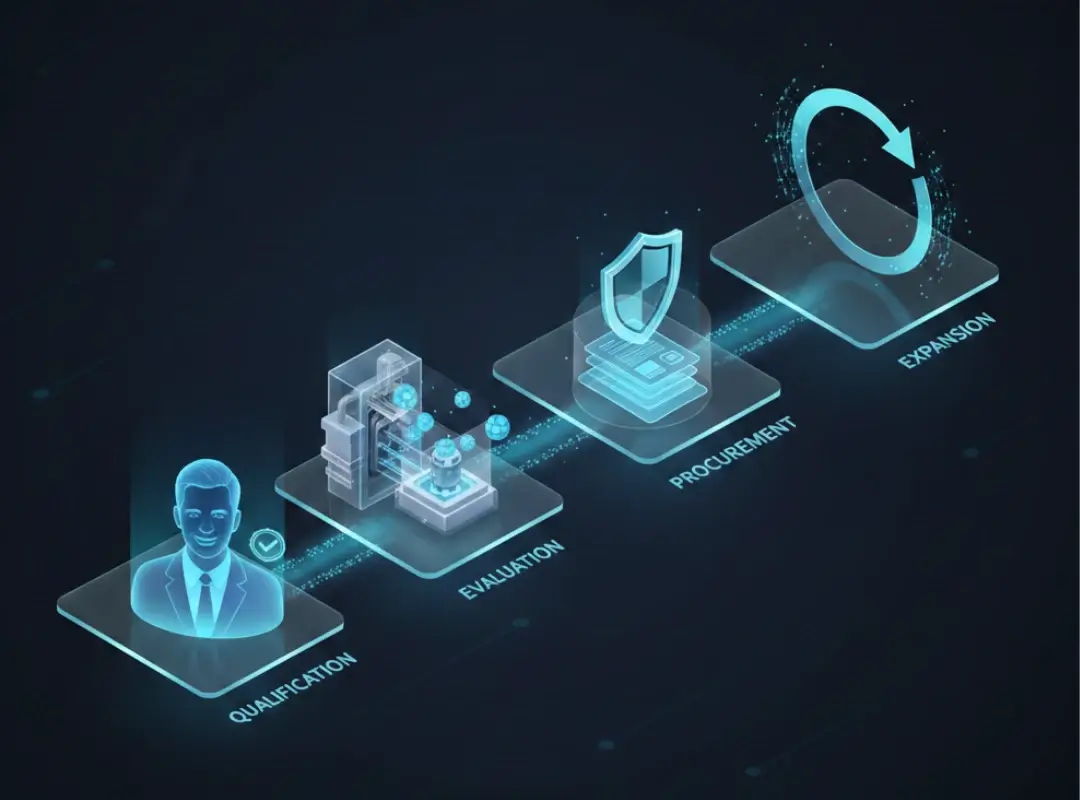
If you’re treating testimonials like “sprinkles,” you’ll get sprinkle results.
Instead, treat them like stage-specific tools: the right story at the right moment.
Qualification: Early Trust Signals
Early stage is not the time for a 4-minute cinematic brand film.
You want quick relevance:
- Same industry (or similar regulatory pressure)
- Same role (CFO-to-CFO, practice owner-to-practice owner)
- Same starting pain (“I was worried about switching,” “I didn’t trust agencies,” “I hated being sold to”)
Think 20–40 seconds. A clean hook. A real face. A real name.
Evaluation: Objection Handling at Scale
Evaluation is where deals wobble.
Your champion is trying to translate your pitch into internal language, and that’s exhausting. So you hand them “proof grenades”, short clips mapped to common objections:
- “Implementation will be a mess.”
- “This won’t work for our setup.”
- “It’s too expensive.”
This is where a proper video testimonial funnel strategy shines, because you’re not guessing, you’re placing proof intentionally by stage. (Here’s a deeper guide to building that map: using testimonials at every stage.)
Procurement: Risk Reversal + Compliance Proof
Procurement doesn’t care that your demo was impressive.
They care about:
- security posture
- contract terms
- governance
- vendor risk
- “what happens if this goes sideways?”
So your testimonials need to sound… grown-up.
The best procurement-stage videos don’t shout. They reassure. They mention real constraints (“We involved legal,” “We needed HIPAA-safe workflows,” “We required audit trails”) and they avoid wild promises.
Renewal and Expansion: Proof Loops
Renewals and expansions are where proof becomes a loop:
- capture outcomes post-implementation
- feed those clips back into Salesforce
- equip CSMs and AEs with “what success looks like” stories
It’s like compounding interest, but for trust. And yes, your customers become your best sales reps (without needing commission).
Three Salesforce Proof Plays (Step-by-Step)
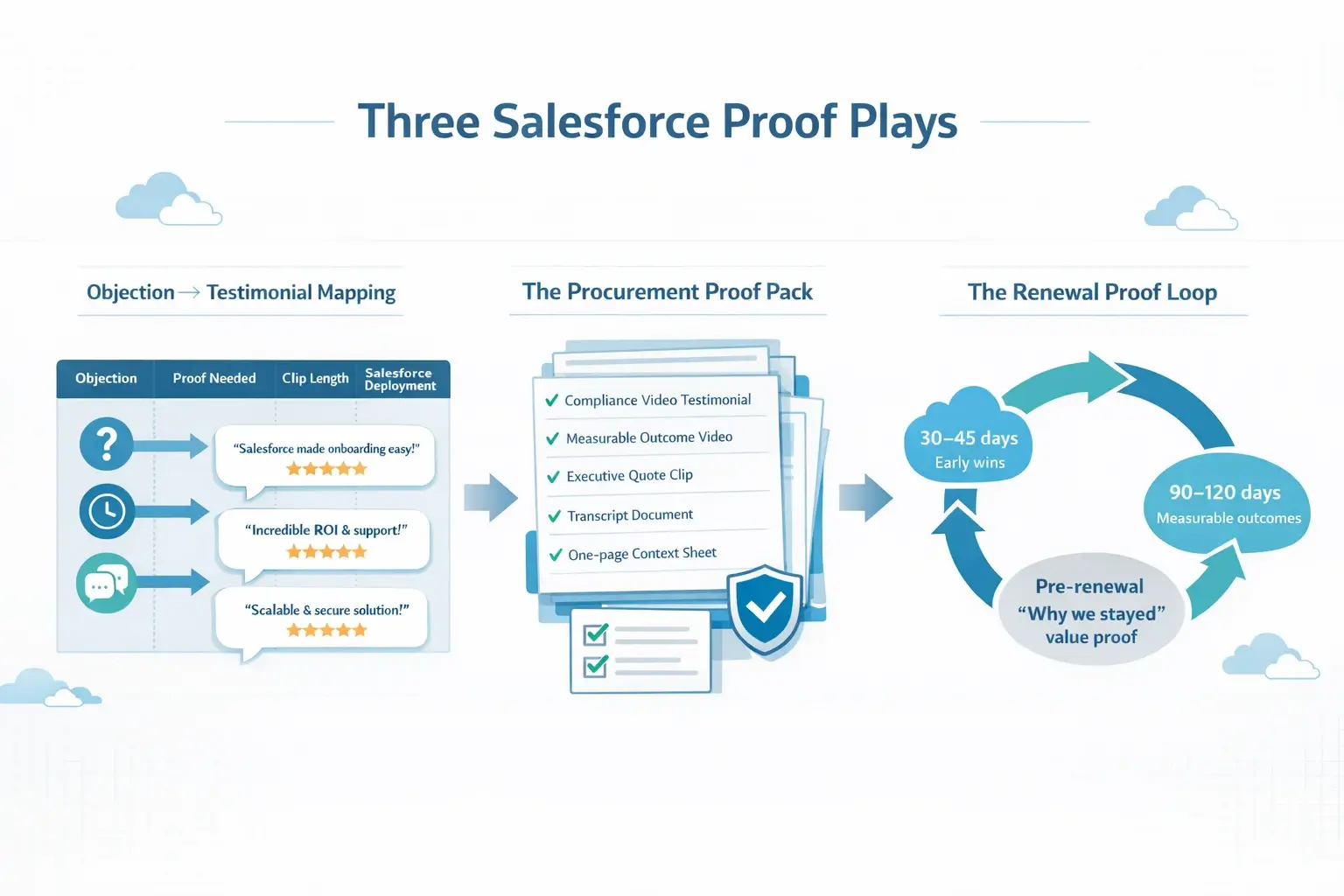
You don’t need 50 testimonials. You need a system.
Here are three plays that work because they’re simple enough to run, but specific enough to measure.
Play 1: Objection → Testimonial Mapping
Build a small library of clips, each one assigned to a single objection, then attach those clips to Salesforce assets (email templates, sequences, opportunity stage guidance).
Objection (what they say)What your testimonial should proveIdeal clip lengthWhere to deploy in Salesforce
“This is too expensive.”ROI, cost avoidance, payback period, time saved20–45 secEvaluation stage email template + ROI follow-up task
“Legal/compliance will block this.”Governance, approvals, risk controls, safe rollout30–60 secProcurement stage checklist + security review enablement folder
“Will this work for me?”Similar buyer profile + before/after outcome20–45 secLate qualification + pre-demo confirmation email
Price Objection
A strong price testimonial isn’t “It was worth it.” That’s fluffy.
You want numbers or specifics:
- “We saved 6–8 hours a week per coordinator.”
- “We reduced no-shows by 15%.”
- “We stopped paying for three tools that overlapped.”
Pro tip: if the customer can’t share exact numbers, ask for ranges (“high five figures,” “about 10–15%”) and tie it to a business moment (“by the second month…”). That stays believable.
Risk/compliance objection
This is where regulated industries win. If you’re in healthcare, finance, or real estate, your best testimonial angle is often how safe it felt.
Have them describe the process:
- “We looped in compliance early.”
- “We had documented steps.”
- “No one had to ‘wing it.'”
If you need SEO-safe and legally safer phrasing guidance, it’s worth keeping an eye on practical compliance and content standards discussed across Search Engine Journal’s marketing coverage (especially around what Google considers helpful vs. hype-y content).
“Will this work for me?” objection
This is the identity objection.
The fastest fix is matching:
- Same role (“I’m a practice owner too”)
- Same stage (“We were at $1.2M and stuck”)
- Same skepticism (“I thought testimonials were cheesy…”)
One of my favorite prompts: “What were you afraid would happen?” The answer is usually the exact fear your next buyer is hiding.
Play 2: The Procurement Proof Pack
When the deal hits procurement, your rep needs a package that feels like it belongs in an executive inbox.
This is where Share One tends to stand out, because we use trained human interview directors to pull out the “risk story”, without turning your customer into a stiff spokesperson.
Assets included + positioning
A clean Procurement Proof Pack typically includes:
- 1 compliance-forward video testimonial (a customer describing approvals, rollout, and safety)
- 1 measurable-outcome video (numbers, time saved, reduced risk)
- 1 short executive quote clip (10–15 seconds of “we’d do this again”)
- Transcript + pull quotes for security/legal reviewers who don’t want to watch video
- A one-page context sheet: who the customer is, their environment, and what’s comparable
Position it like this (feel free to steal the line):
“Here are two peer stories your security/legal team can review, focused on governance, not marketing.”
If you’re building a bigger library across departments, this guide on scaling enterprise video testimonials across teams lays out the operational side.
Play 3: The Renewal Proof Loop
Most teams wait too long to capture the “after.” Then the customer’s memory fades, leadership changes, and your best outcomes turn into… vague good feelings.
Instead, set a recurring Salesforce task for Customer Success:
- At 30–45 days post-go-live: capture early wins (speed, adoption, relief)
- At 90–120 days: capture measurable outcomes (numbers, benchmarks)
- Before renewal: capture “why we stayed” (risk reversal + value realization)
Keep it lightweight. A 15-minute interview can produce 5–10 usable clips when you plan the prompts right.
And yes, this creates an expansion engine. When a new department asks, “Has anyone like us done this?” you can answer instantly with a face, a name, and a story.
Enterprise Testimonial Production Specs
Enterprise buyers can smell a scripted testimonial the way a nurse smells hand sanitizer from across the hallway.
So let’s talk about what works.
Narrative Structure: Problem → Process → Measurable Outcome
The best structure is boring on paper, and persuasive in real life:
- Problem: what was broken or risky
- Process: what changed (steps, rollout, who was involved)
- Measurable outcome: what improved (numbers, time, risk reduction)
If you only capture the “outcome,” you trigger skepticism. The process is what makes the result feel repeatable.
A quick, real example from the field: we once interviewed a financial services founder who kept saying, “We grew a ton.” Cool… but unhelpful.
Once our interviewer asked, “What did your week look like before, and what does it look like now?” he said, “Before, I spent Sundays cleaning up lead follow-up. Now it’s baked into our system, and Sundays are for my kid’s soccer.”
That single line did more selling than the growth claim ever could.
Avoiding Guarantees
If you’re in healthcare or finance, avoid language that sounds like a promise:
- Don’t: “This will guarantee results.”
- Do: “This helped us achieve…”
- Don’t: “Everyone will see the same outcome.”
- Do: “In our case…” / “For our team…” / “With our constraints…”
When you’re unsure, anchor in specifics and context. That’s not just good compliance, it’s good persuasion.
Captions/transcripts
Captions aren’t optional anymore. They’re needed for:
- Accessibility: people watch on mute, especially on mobile
- Extraction: easy to pull quotes for email, decks, battlecards
- Search/discovery: transcripts help content get indexed and found
Google has been clear for years that helpful, accessible content is the goal, so it’s worth aligning with guidance from Google Search Central when you’re publishing testimonial pages or embedding video.
Small execution detail that matters: burn in captions for social clips, but also keep a clean transcript file for your website and your enablement repository.
Measuring Impact in Salesforce
If you can’t measure it, your testimonial program becomes a “nice-to-have” that gets cut the moment budgets tighten.
So measure it like you mean it.
Win Rate, Cycle Time, and Stage Velocity
Start simple. Pick one segment (say, mid-market healthcare) and track directional change:
- Win rate: Closed Won / total closed deals
- Deal cycle time: days from stage entry to close
- Stage velocity: average days in each stage (especially Evaluation and Procurement)
Practical setup ideas:
- Add a custom field: “Proof asset used?” (Yes/No + asset type)
- Log a Sales Activity when a testimonial is sent (template or sequence step)
- Create a report: opportunities with proof vs. without proof
You’re not looking for perfect causality. You’re looking for consistent lift.
Attribution Caveats in Multi-Touch Deals
Multi-stakeholder deals are messy.
A testimonial may:
- help your champion sell internally
- reduce procurement back-and-forth
- revive a deal that was quietly dying
None of that shows up as “last touch.” So don’t let last-touch attribution bully you into thinking proof doesn’t work.
What I like instead:
- Assist tracking: was proof used at any point before stage progression?
- Stage comparison: do deals with proof spend fewer days in Procurement?
- Qualitative notes: ask reps, “Did this clip change the tone of the deal?” (you’ll hear it)
If you want a sales-first deployment approach (not just “put it on your homepage”), Share One’s breakdown of how to run video testimonial sales pairs well with the measurement framework above.
Common Mistakes Enterprise Teams Make
These are the mistakes I see on repeat, usually from smart teams moving too fast.
- Treating testimonials as marketing-only. If Sales can’t find them inside the workflow, they won’t use them.
- Collecting “generic praise” videos. “Great service.” is not proof. You need problem-context-outcome.
- Ignoring procurement. Teams over-invest in early-stage hype and under-invest in risk reversal.
- Using one hero story for everyone. Your CFO buyer and your ops buyer don’t need the same clip.
- Over-scripting. The moment the customer sounds like your website copy, trust evaporates.
- Not capturing transcripts and cutdowns. If the video can’t be repurposed, adoption drops.
- Not operationalizing the ask. Waiting for “superfans” means you’ll collect proof in random bursts instead of building a steady library.
And a quiet one: not having a human interviewer. Founders assume customers can “just record something,” but most people freeze when a webcam light turns on. A trained director makes it feel like a conversation, not an audition.
Build Your Enterprise Proof Pack
If you’re trying to grow in a crowded market, video testimonials aren’t a vanity project, they’re a sales enablement asset that lowers risk, transfers credibility, and gives your champion something solid to carry into the next meeting.
Your next step is simple: build a small, stage-aligned Proof Pack (Qualification, Evaluation, Procurement, Renewal), wire it into Salesforce, and measure win rate + stage velocity like you would any other revenue lever.
If you want the “no awkward asks, no tech hassles” route, Share One can do the heavy lifting, trained human interview directors, authentic customer stories, polished edits, captions/transcripts, and a library your team can deploy.
Start building trust today with Share One: browse through our solutions and get an enterprise proof pack plan tailored to your pipeline.
Looking for proof? Companies love Share One’s done-for-you service, peek through our Case Studies.
Frequently Asked Questions
Where do video testimonials belong in the Salesforce sales process?
Video testimonials belong at specific Salesforce opportunity stages, not just at the end of a deal. Early-stage testimonials build initial trust during qualification, mid-stage videos handle objections during evaluation, and late-stage testimonials reduce risk during procurement. Post-sale testimonials support renewals and expansion by reinforcing value.
What type of testimonial works best for enterprise procurement?
Enterprise procurement teams respond best to executive-level testimonials that focus on risk reduction, implementation credibility, and governance. These videos should explain the decision process, security review, and rollout experience, not marketing claims. Conservative language and measurable outcomes matter more than emotional storytelling at this stage.
How do you use testimonials to handle objections in B2B sales?
Testimonials work best when mapped directly to common objections. Sales teams should match each objection, such as price, risk, or fit, to a customer story that shows how a similar buyer resolved that concern. This allows reps to proactively address objections before they stall deals.
How do you measure whether testimonials shorten the sales cycle?
Measure impact by comparing stage velocity, deal cycle time, and win rate before and after testimonial usage. Track whether deals that include testimonial assets move faster through evaluation and procurement stages. Focus on directional improvement rather than single-touch attribution, since enterprise deals are multi-touch.
How many testimonial videos should a sales team have?
Most enterprise sales teams need fewer testimonials than they expect. A strong baseline is eight to twelve videos covering core industries, deal sizes, and common objections. The goal is relevance, not volume. One well-matched testimonial per opportunity stage is more effective than a large, generic library.