Short vs Long Video Testimonials: What Actually Works?
Learn when short vs long video testimonials convert best, with a simple funnel-based framework, examples, and modular strategies you can reuse fast.
If you’ve ever stared at a raw customer video and thought, “Do I chop this down to 30 seconds or let it roll?”, you’re not alone.
People who watch customer videos are more likely to convert, yet most entrepreneurs still obsess over the wrong thing, length instead of strategy. In a world where over 78% of viewing happens on phones, and attention feels shorter than a TikTok loop, smart video testimonials are less about the timer and more about matching the story to the moment, which is exactly what you’ll unpack here, with concrete examples, a simple decision framework, and some hard-won lessons from the field.
Key Takeaways
- The debate over short vs long video testimonials matters less than matching the right story length to your buyer’s intent, risk level, and funnel stage.
- Short video testimonials (15–60 seconds) work best for cold or mildly warm audiences on social, ads, and emails, where the goal is to spark curiosity and earn a small next step, not close the sale.
- Long video testimonials (2–6 minutes) shine in high-stakes, high-ticket decisions by providing emotional depth, objection handling, and detailed proof that boosts close rates near proposals and sales calls.
- Most underperforming long testimonials fail because of poor structure and loose editing; a clear before–hesitation–experience–after arc and tight cuts make longer stories feel shorter and more compelling.
- The most effective strategy is modular: record one structured interview, then slice it into multiple short vs long video testimonials tailored to ads, website, email nurture, and sales follow-ups across your entire funnel.
Why Video Testimonial Length Is the Wrong First Question
You’ve probably Googled how long should a testimonial video be? and seen the magic number: “2 minutes or less.”
That stat isn’t wrong. It’s just not the whole story.
If you run a clinic, a brokerage, or a financial advisory firm, your buyers aren’t all in the same headspace. Some are just meeting you. Others are comparing you to two competitors with 12 browser tabs open. A few are one tiny nudge away from signing.
Those three people don’t need the same video.
So when you ask, “short vs long?” you’re skipping the real questions:
- Where will this clip live?
- What decision is it supposed to help with?
- How much risk does the buyer feel right now?
Once you answer those, length becomes a tuning knob, not the strategy.
Context Over Duration
A 30‑second patient quote on a billboard-style Facebook ad is perfect.
The same 30 seconds dropped into a serious $15,000 wealth-management proposal? Way too thin.
Where you use the video matters more than how long it runs.
Think about your own funnel:
- Ad or social scroll: people are cold, distracted, half-watching TV.
- Landing page: they’ve clicked, curiosity is higher, and friction is medium.
- Sales call follow‑up: they already know you, but they’re scared of making a bad choice.
Each of those touchpoints deserves a different depth of proof.
Short clips are like appetizers, great for getting someone to sit down at the table.
Longer stories are the main course; no one wants a steak served on a toothpick.
Viewer Intent Determines Everything
A buyer who already has your proposal open is not the same as someone who just saw your reel for the first time.
You’ll usually see three types of viewers:
- Skimmers – They’re bored in line at Starbucks, thumbing through Instagram. Give them a punchy, 15–30 second hit: “I sold my condo for 12% over asking with zero stress.” That’s it. Earn the click.
- Evaluators – They’re on your site comparing options. Here, a 60–120 second story with a beginning, middle, and end works: problem, process, result.
- Decision‑makers – They’re risk‑averse and close to the edge. These folks will happily watch a 3–5 minute story if it calms their fears and answers, “Will this work for someone like me?”
Notice what drives the length: intent, not some universal attention span myth.
Performance of Short Video Testimonials
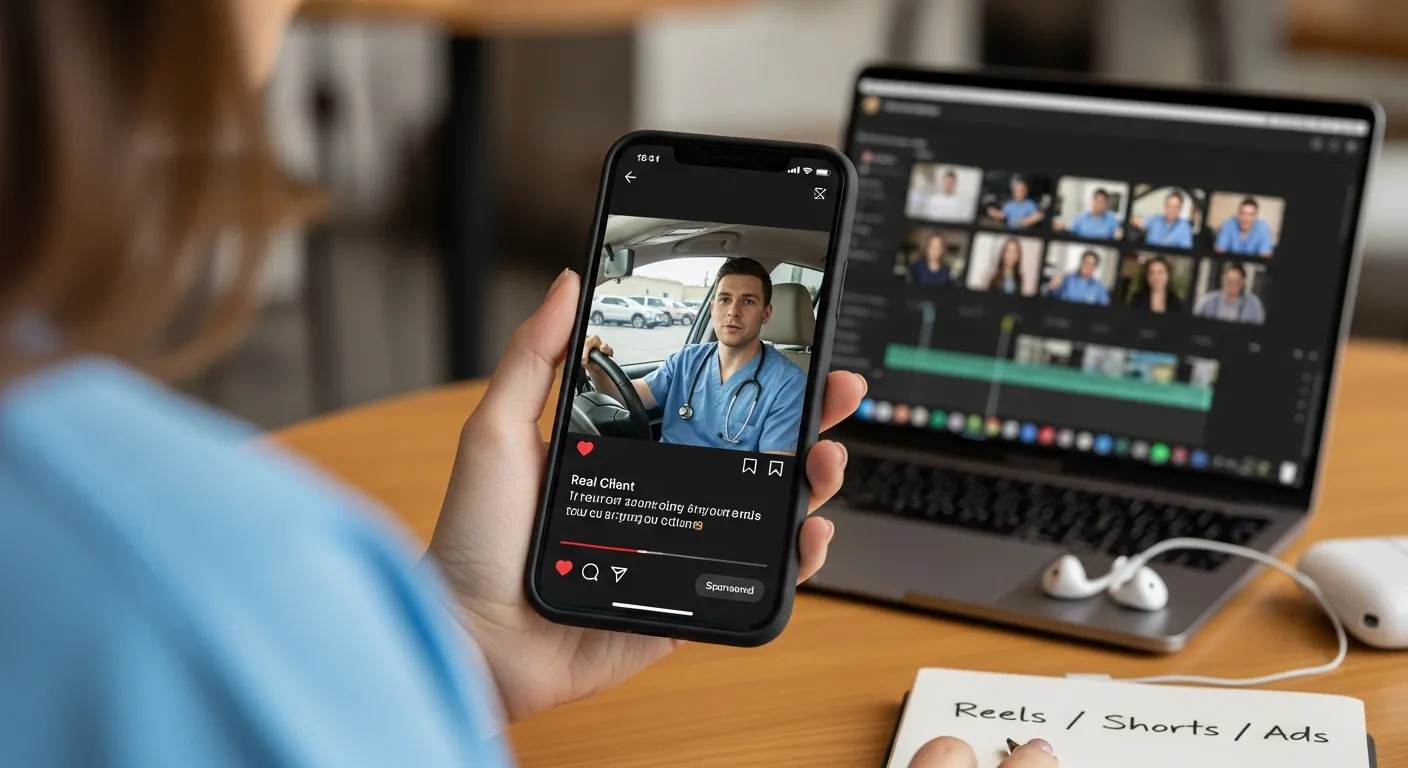
Let’s talk about the short stuff first, those snappy 15–60 second clips everyone loves.
When you’re running ads or posting on social, short testimonials usually win on engagement and completion rates. People finish them. That alone is powerful.
In practice, a “short” clip usually means:
- 15–30 seconds for ads and social scroll
- Up to ~60 seconds for your homepage or quick email embeds
In that window, your goal isn’t to unpack the whole journey. It’s to hit one clear outcome and one clear identity:
“I’m a first‑time homebuyer, and they made the process feel simple, even in a crazy market.”
That’s often all a cold prospect needs to think, “Okay, these people get clients like me.”
Quick note from the trenches: Some of the best-performing short clips are slightly messy. A real patient in scrubs. A client in their car outside your office. Not polished, but honest.
Research says under 2 minutes tends to perform best, but authenticity beats polish every time. Don’t script your clients to death. Give them prompts, not lines.
Best Use Cases for Short Testimonials
Short clips shine when you’re lowering the bar for the next step, not pushing for the final “yes.”
You’ll get a ton of mileage if you drop them here:
- Paid social ads – 20–40 seconds with bold captions and a single promise: more relief, more clarity, more profit.
- Homepage social proof strip – A row of 30–60 second snippets that say, “Real people trust us.”
- Email embeds – A 45‑second patient or client story inside a follow‑up sequence can warm up leads who’ve gone a little cold.
- Organic social – Reels, Shorts, or LinkedIn posts where clients share one quick win.
Think of these videos as trailers, not the whole movie.
Platforms Where Short Testimonials Win
Short clips crush it in places built for swiping:
- Meta (Facebook & Instagram) – You’re battling thumbs. Hook people in the first 2–3 seconds with a bold line on screen.
- TikTok & YouTube Shorts – Vertical, fast‑paced, casual. Great for hooks like, “How I went from 6 months on the market to 6 days.”
- LinkedIn feed – Especially for finance and B2B‑style services. Clean captions, face to camera, one concise message.
The big mistake? Expecting a 20‑second clip on TikTok to close a high‑ticket surgery package or a complex financial planning engagement.
Use short videos to spark curiosity and clicks, not to carry your entire sales argument.
Performance of Long Video Testimonials
Now let’s swing to the other side, those 2–6 minute stories (sometimes longer) that people are weirdly afraid to create.
Longer testimonials aren’t about awareness. They’re about confidence.
In high‑stakes decisions, medical procedures, major investments, and real estate moves, buyers want to hear the whole arc:
- What were they scared of?
- Why did they almost say no?
- What changed after they did it?
When you let a client walk through that journey, you speed up trust in a way a punchy one‑liner never will.
I’ve seen 3–4 minute stories quietly double the close rate on certain offers, simply because they sat right next to the proposal and answered the exact fears prospects were too shy to say out loud.
Trust Depth and Emotional Resonance
Short clips win attention. Longer ones win emotional buy‑in.
In a 3–5 minute story, you have time for:
- Context: “We’d been burned by two advisors before…”
- Struggle: “Every month, our debt was creeping up.”
- Turning point: “We booked a consult, still skeptical, but…”
- Outcome: “Within 9 months we…”
That arc doesn’t just tell people you’re good. It lets them feel what life is like after working with you.
This matters most in healthcare, finance, and real estate because the risk feels huge. People are imagining their health, their savings, and their family’s home.
A longer story, full of specifics, taps into that emotional weight.
Objection Handling and Sales Enablement
Here’s a fun little secret: most people don’t watch long testimonials straight through.
They skim.
They jump around the timeline, listening for the one sentence that answers the question stuck in their head, like:
- “Will this work if I have a complicated medical history?”
- “What if I don’t have a huge down payment?”
- “I’ve tried other advisors. How is this different?”
That’s why long videos are a killer for sales enablement:
- You drop them into proposals.
- You send them after sales calls.
- You reference a specific timestamp: “Skip to 1:42, this client had the same concern.”
Done well, long testimonials act like a calm, third‑party closer sitting at the table with you, saying, “I was skeptical too. Here’s what happened.”
Ideal Testimonial Length by Funnel Stage
If you want a simple way to match length to strategy, use this rule of thumb: the higher the friction, the more proof you need.
That doesn’t always mean more minutes, but often, yeah, it does.
Here’s how to think about length at each stage of your funnel.
Cold Traffic
For cold audiences, think ads, reels, and first‑touch emails, aim for 15–45 seconds.
Your job here isn’t to explain your process. It’s to interrupt the pattern and earn a small next step.
For example:
- Real estate: “We listed on Friday and had 11 offers by Monday.”
- Healthcare: “My chronic back pain dropped from an 8 to a 2 in three weeks.”
- Finance: “We went from terrified of retirement to excited.”
Outcome first. Identity second. Then a soft invite: “Book a quick consult.”
Warm Traffic
When someone’s been on your list, clicked your pages, or followed you for a while, move up to 60–120 seconds.
Now they’ll tolerate a bit more story:
- What life looked like before.
- One or two key moments working with you.
- A concrete result.
This works well on service pages, case‑study sections, or in nurture emails where you’re nudging people closer to booking.
Sales Calls and Demos
Here’s where longer clips finally earn their keep: 2–5 minutes (or a couple of modular clips you can pick from).
Use them:
- Right before a call: “Watch this 3‑minute story from a client like you before we meet.”
- During a call: share screen, play a short segment, then pause and ask, “Does that sound familiar?”
- After a call: send a follow‑up with two timestamps that match their biggest worries.
Suddenly, you’re not the only voice saying you’re worth it.
Retargeting and Decision-Stage Buyers
For people who keep revisiting your site or proposal, mix short hooks plus long‑form proof.
You might run a short 20‑second retargeting ad that leads to a dedicated page with a 3–6 minute case study.
They’ve seen your face. They know your name. At this point, more detail doesn’t feel like “too long”; it feels like reassurance.
(Further reading: Know which type of testimonial to use, dive into our Video Testimonial Types guide.)
Why Most “Long Testimonials” Fail to Convert
If longer stories are so powerful, why do so many 5‑minute videos feel… endless?
Because length isn’t the enemy, lack of video testimonial structure is.
Poor Structure
A lot of testimonial shoots go like this: you hit record, say, “So, how was it?” and let the client ramble.
What you get is a mushy middle:
- No clear “before” picture.
- No specific turning point.
- No sharp, memorable takeaway.
Viewers drift, scrub the timeline, and bail.
A strong long testimonial, on the other hand, follows a simple arc:
- Before – “Here’s what life felt like.”
- Hesitation – “Here’s what held me back.”
- Experience – “Here’s what it was like to work with them.”
- After – “Here’s what changed, numbers and feelings.”
You don’t need a Hollywood script. You just need intentional prompts.
Rambling Narratives and Weak Editing
Another killer of good content? Fear of the trim.
You aren’t obligated to keep every second of what your client said.
Cut the ums, tighten the tangents, and keep the gold: those emotionally loaded lines like, “I slept through the night for the first time in years,” or “We finally stopped fighting about money.”
A 4‑minute video that feels like two will outperform a 2‑minute video that feels like 10.
If you’re editing on your own (phone, Canva, basic tools), you’ll do more for your conversions by cutting 30 seconds of fluff than by buying a fancy camera.
How to Decide the Right Testimonial Length for Your Business
When you’re busy running a practice or firm, you don’t have time to obsess over seconds.
So use this simple mental checklist whenever you plan a client story.
Buyer Awareness Level
Ask yourself: “How much does this person already know?”
- Problem‑aware: They know they’re in pain (debt, back issues, renting forever) but are not sure what kind of solution exists. Use shorter, outcome‑heavy clips to show that change is possible.
- Solution‑aware: They know options exist, physical therapy vs surgery, renting vs buying, robo‑advisor vs planner. Use mid‑length videos (1–2 minutes) that compare experiences and highlight your approach.
- Vendor‑aware: They know you by name. Now they need proof that you’re safe, competent, and worth the money. This is where deeper 3–5 minute stories work well.
Higher awareness = higher patience for longer proof.
Offer Complexity and Price Point
Low‑risk offer? Keep it short.
- Free consults, low‑ticket audits, short check‑ups: a 20–60 second clip can be enough.
High‑ticket or high‑friction offer? Go deeper.
- Full mouth restoration, long‑term wealth plans, selling or buying a home: here, you want more context and detail so buyers feel safe.
The more someone stands to lose if things go wrong, the more they’re willing to watch.
Sales Cycle Length
If your typical buyer decides in a day, you don’t need a 12‑episode documentary.
But if your sales cycle is weeks or months, as it often is in healthcare, finance, and real estate, layer your testimonials:
- Short clips in ads and social.
- Mid‑length videos on landing pages.
- Longer case studies in proposals and follow‑ups.
Your proof should grow with the relationship instead of trying to do everything in one clip.
The Smart Play: Modular Video Testimonials
If you want a strategy that saves time and still checks every box, this is it: go modular.
Record once. Slice many.
One Recording, Multiple Cuts
Here’s what this looks like in real life.
You sit down with a client, on Zoom, in your office, or even via a guided link, and spend 15–20 minutes walking them through smart, structured questions:
- What was going on before we met?
- What worried you about?
- What happened in the first 30 days?
- Where are you now?
From that single conversation, you (or a done‑for‑you service like Share One) can create:
- 3–5 short clips (15–45 seconds) for ads and social.
- 1–2 medium cuts (60–120 seconds) for your homepage and service pages.
- 1 deeper 3–5 minute story for proposals and sales follow‑ups.
Same client. Same story. Different cuts tailored to different stages.
Distribution Strategy Across Channels
Once you have modular pieces, you can plug them into your whole ecosystem:
- Ads: short, outcome‑focused snippets.
- Website: mid‑length stories near your calls‑to‑action.
- Email: quick clips in nurture sequences and post‑call follow‑ups.
- Sales: longer edits shared before or after meetings.
Now you’re no longer asking, “short vs long?”
You’re asking, “Which version of this story belongs here?”
That’s where real leverage and real conversion lift start to show up.
(Know where and how to maximize testimonial impact with our Video Testimonial Distribution guide.)
Share One Creates Short and Long Video Testimonials That Convert
If you strip away the noise, the “right” length is simple: the right story, at the right depth, in the right moment.
Short clips pull people in. Longer stories help them say yes without that knot in their stomach.
The catch is, you’re already juggling patients, closings, or client portfolios. You don’t have hours to plan interviews, coach nervous clients, and edit three different versions for every channel.
That’s where a done‑for‑you partner like Share One makes your life a lot easier.
We handle the guided interviews (so your clients sound natural, not rehearsed), structure each story around clear before/after moments, and then cut everything into modular formats, short, mid, and long, ready for your ads, site, emails, and sales team.
You get authentic, on‑brand customer stories that move the needle, without turning into a part‑time video editor.
If you’re serious about using customer stories to attract better leads and close them faster, start lining up your first three clients in your head right now, and then let Share One turn those relationships into video proof that works on repeat.
Start with Share One➡️
Frequently Asked Questions
What’s the main difference between short vs long video testimonials in a marketing funnel?
Short video testimonials (15–60 seconds) act as attention-grabbing “trailers” for cold or lightly warm audiences. Long video testimonials (2–5+ minutes) are better for warm, high-intent buyers who need deeper proof, emotional reassurance, and objection handling before making a higher-risk decision.
How long should a testimonial video be at different funnel stages?
For cold traffic, aim for 15–45 seconds focused on a clear outcome. For warm traffic on your site or list, 60–120 seconds works well. For sales calls, proposals, and decision-stage buyers, use 2–5 minute testimonials or modular clips that dive into context, fears, and detailed results.
When are short video testimonials more effective than longer ones?
Short testimonials work best in paid social ads, organic social (Reels, Shorts, LinkedIn), homepage strips, and quick email embeds. Their job is to spark curiosity and earn a small next step—like a click or a consult request—not to carry the entire sales argument for complex or high-ticket offers.
Why do longer video testimonials often convert better for high-ticket services?
For medical, financial, or real estate decisions, buyers feel high risk and want the full story. A 3–5 minute testimonial can walk through the before, hesitation, experience, and after, address specific objections, and create emotional resonance—giving prospects enough confidence to move forward with a major commitment.
How do I decide between short vs long video testimonials for my specific offer?
Look at three factors: buyer awareness, offer complexity, and price point. Lower-risk, simple, or early-stage offers do well with short, outcome-heavy clips. Higher-risk, complex, or premium offers benefit from longer, structured stories that explain the journey and remove doubts, especially near the final decision.
What’s the best way to film video testimonials so I can create both short and long versions?
Record a 15–20 minute, structured interview covering before, fears, experience, and results. Then edit one 3–5 minute case-study style video plus multiple shorter cuts (15–120 seconds) around specific outcomes or objections. This modular approach lets you reuse one client story across ads, website, emails, and sales calls.