Video Testimonials: The ROI Case Study You Need
See how one video testimonial ROI case study unlocked 1,000%+ returns, higher conversions, and shorter sales cycles, plus a simple formula to model your own.
If you’re selling high-ticket services in healthcare, finance, or real estate, here’s a stat that should make you sit up a little straighter: visitors who watch customer stories are more likely to convert than those who don’t. In a world where 92% of people trust other people more than your ads, short, honest video testimonials don’t just “look nice” on your site, they speed up trust, shrink your sales cycle, and send strong SEO signals by keeping buyers on your pages longer. Stick with this case study breakdown and you’ll see exactly how others are getting 1,000%+ ROI from simple client videos, plus a step-by-step way to run your own numbers without needing a spreadsheet PhD.
Key Takeaways
- A well-placed video testimonial ROI case study shows that short, authentic customer videos can boost conversions by 45–80%+ on high-intent pages like sales and demo funnels.
- Across coaching, SaaS, and medical practices, simple client videos consistently deliver 100%–1,300%+ ROI by lifting conversions, increasing consults, and lowering effective CAC.
- The core ROI formula is straightforward: (Revenue Gain – Cost of Production) / Cost of Production, making it easy to quantify returns from testimonial videos without complex modeling.
- The most effective testimonial clips follow a clear emotional arc (fear → friction → finding → transformation) and prioritize honesty and clear audio over studio-level polish.
- Strategic placement of these videos at key friction points—above the fold, near pricing, in booking flows, and in follow-up emails—turns hesitant visitors into confident buyers faster.
- Beyond visible revenue gains, video testimonials also shorten sales cycles, reduce objections, and improve lead quality, creating significant hidden ROI that compounds over time.
How We Measure ROI (Replicable Framework)
Let’s start with the part your CFO brain cares about: how do you measure the return on these customer videos, not just vibe-check them?
You’re working with three moving pieces:
- what you earn from the extra conversions these stories unlock,
- what you spend to get them produced,
- and how they quietly shorten your pipeline behind the scenes.
At a high level, the math looks like this.
The ROI Formula Used Across All Case Studies
Here’s the simple formula you’ll see repeated in every example:
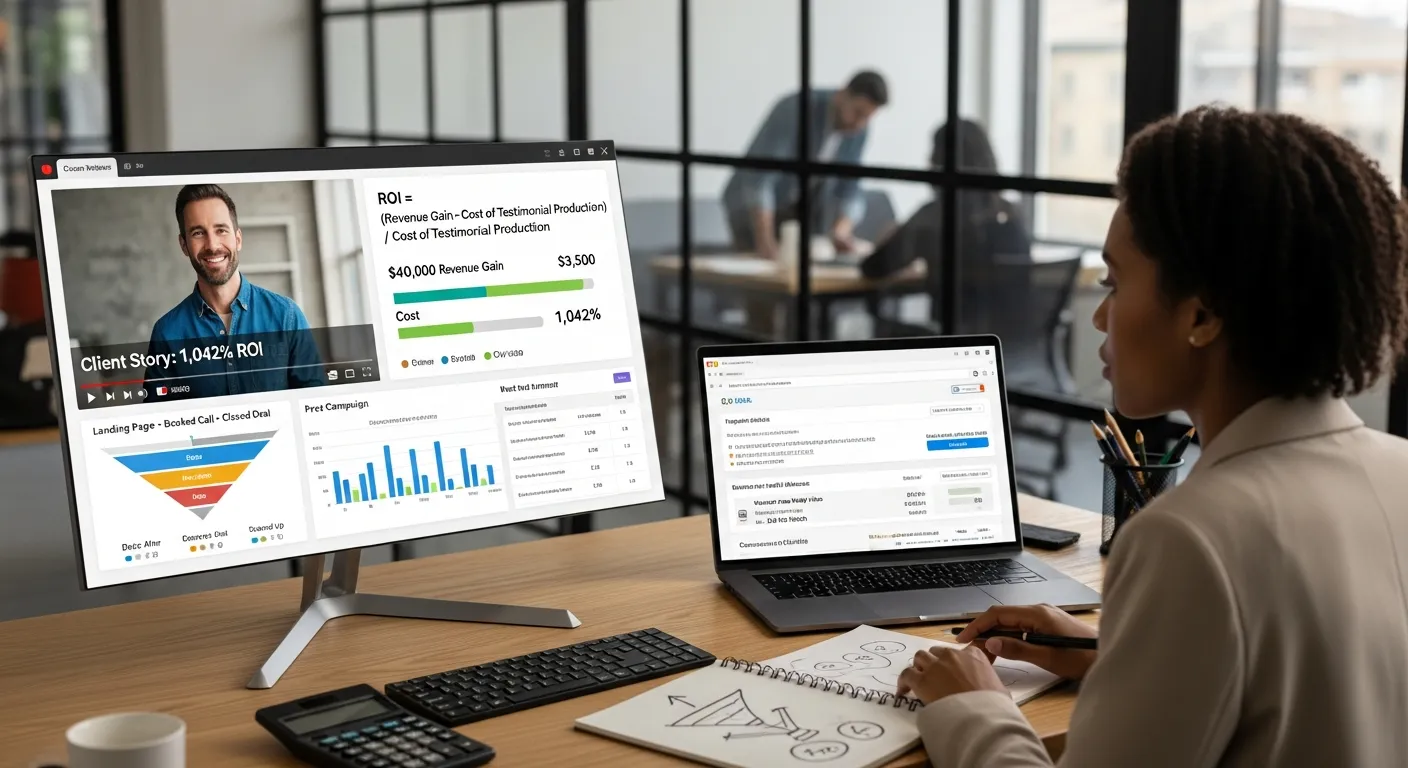
ROI = (Revenue Gain – Cost of Testimonial Production) / Cost of Testimonial Production
So if you spend $3,500 on a small batch of videos and they help drive an extra $40,000 in closed revenue over 60 days, your math looks like this:
- Revenue Gain: $40,000
- Cost: $3,500
- ROI = ($40,000 – $3,500) / $3,500 ≈ 1,042%
That’s not a made-up internet number, that’s the kind of lift you see when the stories are placed at real decision points for high-intent buyers.
Where this gets more interesting is how these videos reshape your CAC and LTV:
- CAC (Customer Acquisition Cost): When the same ad spend starts converting more visitors into booked calls and more calls into clients, your effective CAC drops.
- LTV (Lifetime Value): When trust is higher from day one, clients stay longer, buy more, and refer more. That extra revenue per client also belongs in the “gain” side of the equation.
You don’t need to model every last penny, but knowing these levers stops you from underestimating the impact.
Pre/Post Funnel Measurement
The cleanest way to see the lift is a simple before-and-after comparison on your funnel.
Picture a pretty standard service funnel:
Landing page → Booked call / demo → Closed deal
You grab baseline numbers for 30–60 days:
- Landing page conversion rate (visitor → booked call)
- Show-up rate for those calls
- Close rate (calls → paying client)
- Average revenue per client
Then you plug your customer stories into key spots, like above the fold on the landing page and in your post-opt-in email, and run the same funnel for the next 30–60 days.
The important thing: you’re not just looking at “video views.” You’re asking, “What changed in the funnel once people saw this story?”
That’s where uplift modeling comes in. You don’t assume the entire revenue bump came from the clips, but you also don’t ignore the obvious pattern when the pages with stories suddenly start outperforming the old versions.
Attribution Logic
Here’s where a lot of entrepreneurs overthink things and then give up.
In tools like Google Analytics or HubSpot, you’ll usually see last-touch attribution by default. That means if someone watched your case study, got a follow-up email, then Googled your brand name and booked a call, search “gets the credit,” not the story that calmed their nerves.
A better way is to treat your proof content as a multi-touch influence:
- Tag links under or inside the video (UTMs) so you know when someone clicks to book from there.
- Log in your CRM when reps send a specific clip and track deals that interacted with it.
- Compare close rates for opportunities who watched vs those who never engaged with any story.
And you’ll still miss some upside, there’s hidden ROI that won’t show up in a neat dashboard:
- Shorter sales cycle (decisions in 10 days instead of 30).
- Fewer objections (less back-and-forth email, less discount pressure).
- Better-qualified leads (because the stories are specific enough to attract the right people and repel the wrong ones).
If you sell serious services, like a $8,000 financial planning package, or a long-term healthcare program, this “trust acceleration” is where a huge chunk of your gain lives.
Case Study 1 — High-Ticket Coaching (Anonymous Client)
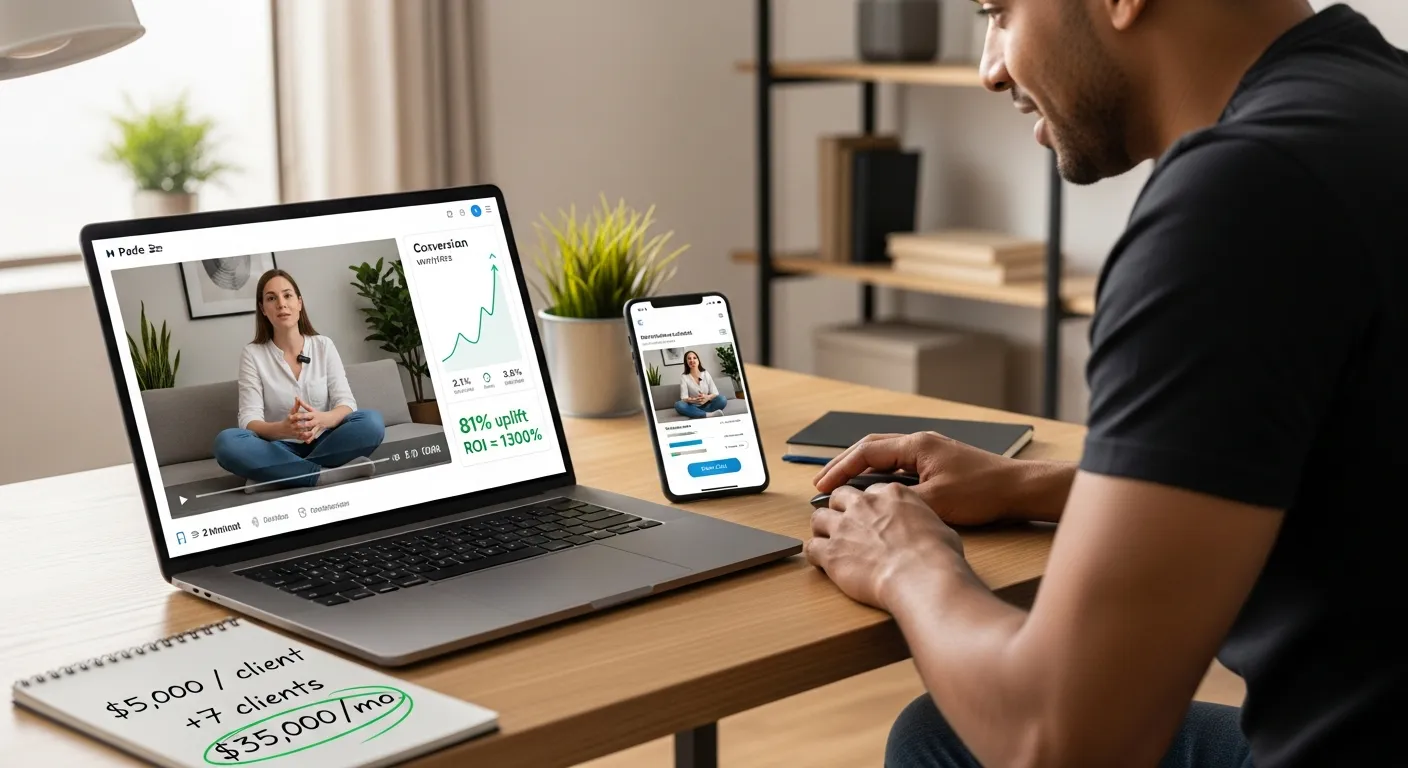
Think of this one like a dress rehearsal for your own funnel strategy.
Problem
A coaching firm selling a $5,000 transformation program had a familiar pain: plenty of traffic, meh conversions.
On paper, everything looked fine, slick landing page, good copy, a decent webinar, but people still hesitated at the final step.
You know that moment when someone is hovering over the “Book Call” button, asking themselves, “Is this going to work for someone like me?” That’s where they were leaking money.
Testimonial Created
They recorded a single 2‑minute, story-driven clip from a past client.
Not a perfectly lit studio shoot. Just a simple, well-mic’d video where the client walked through:
- what they were afraid of before joining (“I’d invested before and felt burned”),
- where they were stuck (income plateaued, constant stress),
- what shifted after working with the coach (new systems, mindset changes),
- the outcome (roughly 3× revenue in under a year).
The emotional arc was clear: fear → struggle → breakthrough → outcome.
They dropped this clip:
- near the top of the sales page,
- once again near the pricing section,
- and inside the call-confirmation email.
Conversion Lift
Before the story went live:
- Sales page conversion: 2.1% (visitor → purchase / enroll)
After the story:
- Sales page conversion: 3.8%
That’s an 81% uplift on a high-ticket offer, just from letting a real human talk for under two minutes.
If you’ve ever stared at your own analytics and thought, “If I could just squeeze 1–2 more sales out of this traffic…”, this is what that looks like in practice.
ROI Calculation
Let’s run the numbers the same way you can for your own practice or firm.
- Cost to produce the clip (planning, filming, editing): $2,500
- Additional conversions per month thanks to the uplift: 7
- Revenue per client: $5,000
Additional revenue from the video each month:
7 × $5,000 = $35,000
Plug into the formula:
ROI = ($35,000 – $2,500) / $2,500 ≈ 1,300%
One very human story, recorded once, paid for itself in just a few days of enrollments, and kept generating profit every month after.
Case Study 2 — SaaS Company
Now slide over to a B2B SaaS team selling into clinics and financial firms, shorter demos, more stakeholders, plenty of skepticism.
Increased Demo Bookings
Their biggest chokepoint was the demo page.
People landed there, skimmed features, then did the quiet comparison dance in 10 other tabs.
The team added two short customer clips:
- one 60‑second story from a healthcare operations lead talking about reduced admin headaches,
- one from a finance director explaining how the platform made audits less painful.
Both videos sat above the fold, with a simple headline like, “See how teams like yours use this every day.”
Results:
- Demo request rate before: 4.2%
- After adding the stories: 6.1%
That’s a 45% lift in demo bookings from the same traffic.
They didn’t stop there. They sliced the clips into four short cuts for retargeting ads, each one focused on a single objection.
Net effect: more high-intent traffic coming back to that demo page already warmed up by someone who “looks like them.”
Reduced Sales Friction
On the sales side, reps started sending the videos as part of their follow-up.
Instead of answering the same “Will this work for my team?” question three different ways over three different emails, they’d drop a line like:
“Here’s a 90‑second story from another clinic director who had the same concern.”
What changed:
- Objection handling shrank from 3–4 emails to about 1 in many deals.
- The sales cycle sped up by roughly 15%.
- Reps reported that prospects arrived to calls noticeably calmer and more decisive.
You won’t always see that full impact in a clean attribution chart, but you feel it, in faster closes, fewer discounts, and team morale that doesn’t crater every quarter.
Case Study 3 — Medical Practice
If you’re in healthcare, you already know: no one books a procedure if they don’t feel safe.
Trust Multiplier Effect
A multi-location medical practice was getting traffic, but consultations lagged.
The site felt polished… maybe too polished. Lots of stock photos, not many real people.
They brought in a handful of real patient stories, short, unscripted clips about:
- what they were scared of before the visit,
- why they chose this clinic,
- what the experience felt like,
- and how life looked a few months later.
They placed these clips on:
- the homepage hero section,
- each key treatment page,
- and a “Meet the Doctor” area.
Over the next stretch, 72% of new patients mentioned “seeing real patients” as a big reason they felt comfortable booking.
Consultation Rate Lift
Let’s talk hard numbers.
Before the stories:
- Average consultations per week: 8.5
After:
- Average consultations per week: 13.2
That’s roughly a 55% increase.
Production cost was around $3,000 for the set.
With about 20 extra consultations per month and an average of $300 in revenue per consult, that’s:
20 × $300 = $6,000 in additional monthly revenue
Month-one ROI:
($6,000 – $3,000) / $3,000 = 100%
Every month after that, those same stories were essentially pure profit.
Patterns Across All Case Studies
When you line these stories up side by side, from coaching, to SaaS, to healthcare, the same patterns keep showing up.
Emotional Arc
The clips that convert don’t sound like mini commercials.
They sound like a friend over coffee.
The rough arc is always some version of:
- Fear – “I was worried about wasting money / getting hurt / looking stupid.”
- Friction – “I tried X and it didn’t work… I was stuck.”
- Finding – “Then I found this provider and decided to try.”
- Transformation – “Here’s what changed and what life looks like now.”
Authenticity beats polish every time. A slightly imperfect, honest clip will outperform a glossy, stiff shoot nine times out of ten.
Placement
Where you drop the videos matters as much as what they say.
Here’s a quick cheat sheet based on what tends to work across service businesses:
PlacementTypical Impact Range*
Above-the-fold landing page+20–50% more conversions
Pricing / packages page+15–35% more CTA clicks
Demo / consult booking flow+18–30% more bookings
“Meet the team” / doctor pages+10–25% more inquiries
Email sequences (nurture & BOFU)Higher reply + faster closes
*Not guarantees, just realistic ranges from real funnels.
Bottom line: put the stories where your buyer hesitates, not buried in a random “Media” tab.
Delivery Format
A few small format details pull heavy weight:
- Length: Aim for 60–120 seconds. Long enough for a full arc, short enough to hold attention on mobile.
- Orientation: Vertical or square plays nicer on phones and inside email. Over 60% of views happen on mobile now, so design for the small screen first.
- Sound: Clear audio beats perfect lighting. A quiet room and a decent mic on a smartphone is plenty.
- Cuts: One master story + several short cuts (“snackable proof”) tends to outperform a single long clip.
Clusters of proof, what I like to call a social proof swarm, work incredibly well: a main story video, surrounded by a few quotes and stars. It feels less like a one-off fluke and more like a pattern.
Want more proof? Head on over to our Case Studies and find out how Share One drives measurable ROI across coaching, SaaS, healthcare brands, and more.
How to Calculate Your Own Testimonial ROI
Let’s put this in your world for a minute, your practice, your firm, your book of business.
Here’s a simple way to run the numbers without turning into a full-time analyst.
Step 1: Grab your baseline.
For one key funnel (say, “Lead magnet → Call → Client”), jot down for the last 30–60 days:
- Visitors to the relevant page
- Call / demo booking rate
- Close rate
- Average revenue per new client
Step 2: Add 1–3 real stories at key friction points.
Above the fold on the main page. Near pricing. In the reminder emails.
Keep each clip under two minutes, and let your client talk like a human, not a spokesperson.
Step 3: Re-measure for the same time window.
Compare:
- New booking rate
- New close rate
- Any change in average deal size or package choice
Step 4: Do the math.
Calculate the extra clients and revenue.
Then plug it into the formula:
ROI = (Revenue Gain – Cost of Production) / Cost of Production
Even a modest scenario, let’s say an 18% lift in consultations and one extra retained client per month, often covers your video cost quickly, especially in high-value fields like financial planning or specialty care.
And remember the hidden boosts: lower CAC over time, better-fit clients, and fewer soul-draining sales calls with people who were never going to say yes anyway.
Final Thoughts: The Real ROI of Video Testimonials
When you strip away the buzzwords, the real value of these customer stories is pretty simple:
They help serious buyers feel safe saying yes, faster.
That’s why you see booked calls jump 20–70%, sales cycles shrink by 15–20%, and ROI numbers in the 1,000% range when they’re done and placed well.
You don’t need a Hollywood crew, a six-figure budget, or a big-brand logo wall.
You need a handful of real clients, telling the truth about where they were, what you did together, and where they are now, captured cleanly, then woven into your most important touchpoints.
If you’re tired of explaining yourself on every sales call, or watching warm leads quietly drift away, this is one of the highest-ROI moves you can make in the next quarter.
Pick one offer, one page, and one great client story, and start there. Then, once you see your own numbers move, scale the stories the same way you scale everything else in your business.
Start Building Trust with Customer Stories ➡️
Frequently Asked Questions
What is a video testimonial ROI case study and why does it matter for high-ticket services?
A video testimonial ROI case study shows, with real funnel and revenue data, how client videos impact conversions, CAC, and LTV. For high-ticket services in healthcare, finance, or real estate, it demonstrates how short, honest customer stories can drive 1,000%+ ROI by lifting conversions and shortening sales cycles.
How do you calculate ROI from video testimonials in a real case study?
Use a simple formula: ROI = (Revenue Gain – Cost of Testimonial Production) / Cost of Testimonial Production. Compare funnel performance before and after adding client videos, measure extra sales or consultations, multiply by average revenue per client, then plug those numbers into the formula to see true video testimonial ROI.xplain value, show outcomes, and validate purchase decisions, improving engagement and conversion rates throughout the funnel.
Where should I place testimonial videos in my funnel to maximize ROI?
Place testimonial videos at friction points: above the fold on landing pages, near pricing or packages, on demo/consult booking pages, and in nurture or BOFU emails. Case studies show these placements can boost conversions 20–70% and significantly improve the ROI of video testimonial campaigns.
What makes a high-converting video testimonial for ROI-focused case studies?
High-performing clips follow an emotional arc: fear, friction, finding, transformation. They’re 60–120 seconds, unscripted but structured, with clear audio and a specific outcome. Authentic, slightly imperfect stories usually outperform polished “commercials” and create stronger video testimonial ROI in real-world case studies.
How many video testimonials do I need to see a measurable ROI lift?
You can see meaningful gains from just 1–3 strong client stories placed strategically. Many video testimonial ROI case studies start with a single 2‑minute clip and still report 45–80% conversion lifts. Once you validate the impact, you can scale into a small “proof swarm” of videos and quotes.