Video Testimonials for Enterprise Sales That Influence Buying Committees
Learn how video testimonials for enterprise sales de-risk big deals, calm buying committees, and boost late-stage conversion with role-specific proof.
If you’ve ever watched a seven‑figure deal quietly die in “legal review,” you already know this: enterprise buying has almost nothing to do with your feature set.
Buyers aren’t asking, “Is this the coolest platform?” They’re asking, “Will I get fired if I pick these folks?” That’s why thoughtfully built video testimonials can lift conversions, not because they’re flashy, but because they de‑risk the decision, calm the room, and give your champion cover when the knives come out in the committee.
Let’s walk through how to use customer stories as serious enterprise proof, who they need to convince, which formats work, where they fit in your deal cycle, and how Share One can help you turn “we love it, but…” into signed contracts.
Key Takeaways
- Enterprise buying is driven by risk management, not features, so video testimonials for enterprise sales must reassure each stakeholder—champion, economic buyer, technical buyer, and legal/procurement on their specific fears.
- The most effective enterprise video testimonials are short, role-specific clips (champion-forward, technical/implementation, executive outcome, and procurement-safe) instead of one generic highlight reel.
- Packaging proof into structured “proof bundles” with a focused video, transcript highlights, and contextual bullets makes it easy for champions to circulate credible evidence inside buying committees.
- Placing the right testimonial clip at the right pipeline stage—shortlist validation, security review, procurement, and executive sign-off—directly reduces time in stage and increases late-stage close rates.
- Measuring impact by stage conversion, time-in-stage, and segment-specific win rates shows where your testimonial library is strong and where you need new stories to de-risk future deals.
- Platforms like Share One help teams operationalize video testimonials for enterprise sales by capturing human, legally safe stories and turning them into reusable sales infrastructure rather than static marketing assets.
Why Enterprise Deals Stall: Risk Beats Features Every Time
Enterprise sales is not a product bake‑off.
It’s a risk‑management exercise.
You can run the best demo of your life, have every feature checkbox lit up like Times Square, and still lose to… “no decision.” Why? Because nobody wants to be the one who backed the wrong vendor.
The Reality of the Enterprise Buying Committee
Most founders imagine one rational buyer.
What you have is a small political ecosystem:
Champion
This is your internal hero, the director of RevOps, the VP of Patient Experience, the regional banking leader, who discovered you, sat through the first call, and genuinely believes you’re the right choice.
They’re not just buying your product. They’re buying career upside.
But your champion also knows something you don’t see from the outside: if things go sideways, their name is on the slide when leadership asks, “Who approved this?”
So they hunt for one thing above all: peer validation.
They want to hear someone in their same role say on camera:
“I fought hard for this vendor, and it was absolutely the right call.”
That’s the line that gets screenshotted into internal emails and Slack threads.
For a deeper look at how to turn those clips into active deal infrastructure, this guide to Enterprise Sales Enablement Video Testimonials covers persona-specific deployment, objection handling through peer validation, and integration with tools like Salesforce and HubSpot.
Economic Buyer
This is the CFO, VP Finance, or P&L owner.
Their job is to defend the budget in front of a room that barely knows what your product does. They don’t care about fun UI details. They care about a clean, board‑safe narrative:
- “We reduced claim processing time by 27% in 90 days.”
- “We recovered the annual subscription in the first quarter.”
When they watch a customer clip, they’re silently asking:
- Does this sound like our world, our deal sizes, our timelines, our risk profile?
- Would I be comfortable repeating these numbers in a board pack?
If your stories don’t answer those questions, the deal drifts.
Technical Buyer (Security / IT)
Security, IT, data, these folks are professional skeptics.
They’ve been burned by pretty marketing videos that magically forget to mention “oh, we’ll need production access to everything” until after the signature.
So they’re scanning for implementation risk:
- “How painful was onboarding?”
- “Did they clear security review without drama?”
- “What broke, and how fast did support respond?”
They trust calm, specific language way more than hype. A low‑key engineer saying, “Integration took two weeks, single sign‑on was straightforward, and the audit logs checked out,” is gold.
Legal / Procurement
Legal and procurement are not there to help you close. They’re there to make sure nobody does something regrettable.
They’re looking for claims they can’t defend:
- Wild ROI promises
- Vague compliance statements
- Anything that sounds like a legal liability later
If your customer proof is full of big, splashy, unqualified boasts, legal doesn’t lean in. They dig in.
That’s why your enterprise‑ready video stories need to sound almost boring from a lawyer’s point of view, precise, conservative, and easy to sign off.
The Real Objections That Kill Enterprise Deals
On the surface, you hear:
- “We need more time.”
- “We’re re‑prioritizing.”
- “Let’s revisit next quarter.”
Underneath, the real objections usually look like this:
- Implementation risk – “What if this derails our team for six months and still doesn’t work?”
- Security and compliance fears – “Are we going to flunk our next audit because of this?”
- Vendor longevity and credibility – “Will these folks even exist in three years?”
- ROI skepticism and budget defense – “What do I say when the CFO asks, ‘Why this and not headcount?'”
Notice what’s not on that list: “We wish you had one more feature.”
I’ve sat in on internal recap calls where the champion said, “Honestly, I love them, but I don’t have anything solid to show my CFO. It’s all just… vibes.” That’s the death sentence.
Your job is to arm every buyer with proof that survives internal scrutiny. Not sizzle. Not brand fluff.
Concrete, role‑specific reassurance.
For a broader look at how different B2B buyer roles respond to different testimonial formats, the B2B video testimonial examples guide covers everything from short homepage proof clips to ROI-focused decision-stage assets.
Testimonial Formats Built for Enterprise Stakeholders
Most companies treat video testimonials like a generic homepage decoration. One shiny 3‑minute montage that tries to please everyone.
Enterprise buyers don’t work that way, so your stories can’t either.
You need different clips for different people, tuned to what each one is scared of.
Champion-Forward Clips (Internal Shareable Proof)
These are short, punchy, and easy to forward in a Slack thread.
Think 45–90 seconds. The vibe is: “Hey, I was in your shoes. I stuck my neck out. It paid off.”
Core beats to hit:
- Before: “We were stuck in a six‑month backlog / losing deals / missing SLAs…”
- Decision: “We chose this vendor even though there was internal pushback.”
- After: “Here’s what changed, and yes, I’d do it again.”
This is what your champion drops into an email with the subject line: “This is what I’m proposing for us.”
Technical / Implementation Clips (Risk Compression)
Here you want calm, detailed, zero‑hype language. Picture a lead engineer talking to another engineer over coffee.
Good lines sound like:
“Security review took about three weeks end‑to‑end. We didn’t hit any red flags.”
“The integration with our EMR only required light support from their team.”
Walk through:
- Onboarding timeline
- Key integrations
- Security posture and audits
- How support handled bumps
You’re not trying to excite IT. You’re trying to lower their blood pressure.
Executive Outcome Clips (Value Narrative)
These are for the economic buyer and executive sponsors.
Different lens, different story:
- One clear before/after statement
- 1–3 concrete metrics (revenue, cost, time, risk)
- A crisp timeline: “We saw X in 90 days.”
Example:
“Within the first quarter, our win rate on enterprise deals increased from 22% to 31%, and the deals spent 30% less time in security review.”
This is the quote that ends up in a board deck.
“Procurement-Safe” Clips (Claims-Controlled Proof)
Finally, you want a version that legal and procurement can live with.
That means:
- Conservative, factual wording
- No sweeping guarantees
- No numbers your customer’s lawyers will want to walk back later
Instead of:
“We guaranteed a 5x ROI in 60 days.”
Say:
“Our team recouped the first‑year investment in about six months based on reduced rework and higher close rates.”
The trick here is to pre‑negotiate the language with your customer and (ideally) run it through their legal once. Then you have a piece of proof you can reuse in deal after deal without triggering redlines.
How to Package Proof for Enterprise Sales
Raw customer videos sitting in a Google Drive folder don’t close deals.
Enterprise sellers need proof that’s easy to drop into the actual buying workflow.
The Enterprise “Proof Bundle”
Think of a “proof bundle” as a mini press kit for one customer story.
A solid bundle usually includes:
- One short video clip – tailored to a stakeholder type
- Transcript highlights – 3–5 bolded lines someone can skim in 10 seconds
- Three bullets of context –
- Who they are (industry, size, region)
- What they were struggling with
- What changed and how fast
- Optional quote tile + logo – if you have permission
Now your champion doesn’t have to write a novel. They can drop the bundle into an email like:
“Here’s how another regional hospital system solved the same security review bottleneck.”
Where Proof Bundles Get Used
Once you build proof this way, it starts showing up everywhere:
- In digital deal rooms, right alongside pricing and security docs
- As an appendix in proposals, especially in RFP responses
- Inside internal champion emails and Slack threads, where the real debate happens
- In your late‑stage follow‑ups: “Thought this story might be helpful as you prep for your steering committee.”
Getting consistent, role-specific proof into your pipeline at scale requires more than a great interview or two. A structured enterprise video testimonial program lays out how to tag stories by buyer type, sales stage, and objection so reps always have the right clip for the right committee member.
To deep dive on leveraging video testimonials to close more sales and deals, peek at our Video Testimonials for Sales Teams guide.

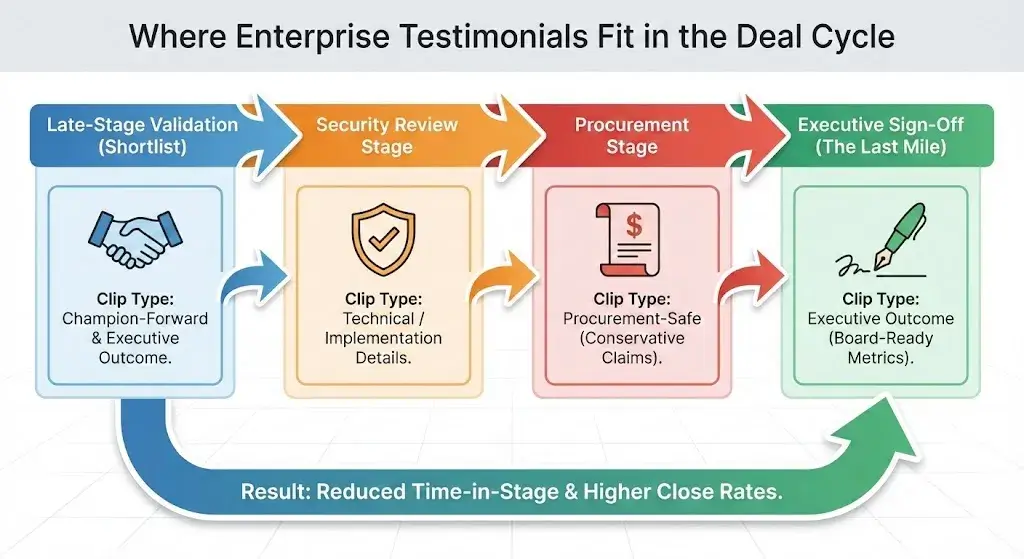
Where Enterprise Testimonials Show Up in the Deal Lifecycle
These stories matter most when the deal is almost there, and at serious risk of falling apart.
Think of your pipeline stages and ask, “What’s the fear right here, and which proof clip answers it?”
Late-Stage Validation
You’ve made the shortlist. Everyone likes you. Nobody wants to be first.
This is where champion‑forward and executive outcome clips shine:
- “We chose them over two larger vendors and here’s why.”
- “Our board felt comfortable because…”
Used well, these turn soft enthusiasm into, “Okay, let’s move this to final review.”
Security Review Stage
Now the conversation shifts from “Is this valuable?” to “Is this safe?”
Drop in your technical / implementation clips:
- Another CISO or IT leader calmly explaining how security review went
- Specifics on audits, certifications, and what access was required
If your video sounds like a real hallway chat between two security leaders, you’re doing it right.
Procurement Stage
Procurement’s job is to squeeze risk and cost.
Here you lean on those procurement‑safe clips and conservative language:
- Emphasis on contract clarity
- Predictable pricing
- Stories of renewals and long‑term relationships
You’re signaling, “We’re not a grenade you’re handing to your colleagues. We’re a known quantity.”
Executive Sign-Off Stage
The last mile.
Now the question is: “Does this align with our strategic priorities, and is the upside worth spending political capital?”
Executive outcome clips, especially when they mention similar company size, region, or regulatory environment, help a lot here.
You want a CFO or COO on camera saying things like:
“This helped us hit our enterprise revenue target a quarter early.”
“It reduced variance and made our forecasts more reliable.”
That’s language executives can copy‑paste into their own justification decks.
Learn how video testimonials accelerate deals for sales teams with our Salesforce Sales Enablement Video Testimonials guide.
Measuring the Impact of Enterprise Testimonials
Vanity metrics are tempting.
Views, likes, play rate, they’re fine for marketing dashboards, but they don’t tell you if your stories are moving deals.
Here’s what to track.
Stage Conversion Improvements
Compare opportunities that used a proof bundle against those that didn’t.
Watch:
- Shortlist → Security review
- Security review → Procurement
- Procurement → Closed‑won
Even modest lifts at each step compound. A few clients I’ve seen who took this seriously ended up with 10–30% better conversion through late stages once reps consistently attached the right clip to the right email.
Time-in-Stage Reduction
Enterprise deals love to linger.
So look at time spent in each late stage for:
- Deals with tailored testimonials
- Deals without them
If your security stage usually drags for 60 days and drops to 40 when IT gets a strong implementation clip, that’s a huge win. Same pipeline, faster cash.
Win Rate by Segment
Not all proof is universal.
Tag your stories by:
- Industry (healthcare, finance, real estate, SaaS, etc.)
- Deal size
- Primary objection they address (security, ROI, change management)
Then compare win rates:
- Healthcare deals with healthcare proof vs. without
- Finance deals with strong ROI stories vs. generic “we love the product” quotes
You’ll spot gaps fast: “We close real estate like crazy when we show those compliance clips, but we have almost no security‑focused proof for banking.” That tells you exactly which testimonial to film next.
Next Steps: Build an Enterprise-Ready Proof System with Share One
If all of this sounds like a lot to orchestrate on top of running discovery calls, forecasts, and QBRs, you’re not wrong.
You’re being asked to build a mini media team and a legal‑safe proof library.
That’s where Share One earns its keep.
Share One is built for this exact problem: turning your best customer wins into stakeholder‑specific, enterprise‑safe stories you can drop into deals.
Here’s what that looks like in practice:
- Human‑first interviews – Real producers (not bots) guide your customers so they sound like themselves, not like they’re reading a brochure.
- Stakeholder‑tuned clips – Champion‑forward, technical, executive, and procurement‑safe cuts from the same conversation, each framed for a different buyer.
- By Humans, For Humans™ storytelling – Tight, emotional arcs that still pass legal review. No overblown claims, no cringe scripts.
- Easy distribution – Ready‑to‑use proof bundles with video, transcripts, and key bullets your reps can paste into deal rooms, proposals, and internal emails.
One SaaS team selling into hospital systems used Share One to capture a 90‑second story from a Chief Nursing Officer who’d championed them. That single clip, plus a short implementation segment from the CIO, started showing up in every late‑stage opportunity. Within two quarters, they saw security review times shrink and their enterprise win rate jump enough that the CRO literally called the testimonial library their “quiet top performer.”
If you want your customer stories to do more than sit on a pretty webpage, it’s time to treat them like sales infrastructure, not side projects.
Let Share One help you build that infrastructure.
Get your first enterprise‑ready proof bundles in motion with Share One ➡️
Frequently Asked Questions
How do video testimonials for enterprise sales actually help close bigger deals?
Video testimonials for enterprise sales work by de‑risking the decision for a complex buying committee. They give champions peer validation, arm CFOs with board‑safe numbers, calm Security and IT about implementation risk, and reassure Legal with precise, conservative claims—all of which move late‑stage deals toward signed contracts.
What types of video testimonials are most effective in enterprise sales cycles?
The most effective enterprise video testimonials are stakeholder‑specific: champion‑forward clips for internal sharing, technical and implementation clips for Security and IT, executive outcome clips focused on ROI and timelines, and “procurement‑safe” versions with conservative, legally vetted language. Each format addresses a different risk that can stall large deals.
Where should I use video testimonials in the enterprise buying journey?
Use them in late‑stage validation, security review, procurement, and executive sign‑off. Champions can drop proof bundles into internal emails, RFP appendices, digital deal rooms, and late‑stage follow‑ups. The goal is to answer the dominant fear at each stage with a tailored clip that feels role‑specific and credible.
How should I structure a proof bundle around a customer video testimonial?
A strong proof bundle includes: one short, stakeholder‑specific video clip; 3–5 transcript highlights; three bullets of context about the customer (who they are, their problem, what changed and how fast); and an optional quote tile and logo. This makes it easy for champions to forward proof without writing long explanations.
What is the ideal length for video testimonials for enterprise sales?
Short and focused works best. Aim for 45–90 seconds for champion‑forward clips and executive outcomes, and 60–120 seconds for technical or implementation clips that need a bit more detail. In enterprise sales, stakeholders skim; concise, role‑specific segments perform better than a single long, catch‑all video.
How can I measure the impact of video testimonials on enterprise deal performance?
Track sales metrics rather than vanity views. Compare opportunities with and without proof bundles for stage‑to‑stage conversion, time in each late stage (especially security and procurement), and win rate by segment or industry. Tag stories by objection type (security, ROI, change management) to identify which clips materially improve enterprise outcomes.