Video Testimonials vs Written Reviews: What Really Works
Video testimonials vs written reviews: see why buyers trust on-camera stories over static text reviews every time.
“Can a two‑minute customer video really beat a wall of five‑star reviews?” Short answer: yes, by a wide margin. Brands that add social proof in rich formats like video see visitors become more likely to convert, and because people trust other people far more than ads, those on‑camera stories do a lot of heavy lifting for you.
If you work in healthcare, finance, or real estate, you already know how crowded and skeptical the market feels. Everyone has glowing text reviews, but fake ratings, anonymous profiles, and copy‑and‑paste comments have trained your buyers to squint at every sentence. Authentic video testimonials flip that dynamic: real faces, real voices, real context, and a serious SEO bonus from higher engagement and longer time on page.
You’re about to see why text‑only feedback is losing influence, what happens in the brain when someone watches a testimonial, the complex numbers behind conversion lifts, and how to use both formats, without burning hours you don’t have. We’ll walk through practical, time‑saving ideas and real stories from service businesses like yours so you can turn reviews into a reliable lead engine, not just a vanity metric.
Key Takeaways
- In the battle of video testimonials vs written reviews, video wins because real faces, voices, and context create stronger trust and emotional connection than anonymous text ever can.
- Video testimonials consistently outperform written reviews on conversion, often lifting key page performance and dramatically improving recall of your message.
- Written reviews still matter for scale, SEO, and quick skimming, but they work best as supporting proof that amplifies the impact of strategically placed video testimonials on core pages.
- Authentic video testimonials (imperfect, unscripted, and under two minutes) feel more like honest conversations and avoid the “overproduced ad” trust problem.
- The most effective social proof strategy combines both formats: use short testimonial videos at key funnel stages and surround them with targeted written reviews and mini case studies matched to each audience segment.
Do you need volume or testimonials that convert? Read our comparison guide, Share One vs REVIEWS.io.
The Shrinking Power of Text: Why Written Reviews are Losing Influence
Scroll through any Google listing or Zillow profile these days, and the text reviews all start to blur together.
Same phrases.
Same five stars.
Same “John was amazing…” that somehow sounds… not amazing.
You’re not imagining it; written reviews don’t carry the weight they used to. They still matter (we’ll come back to that), but on their own, they’re like a handshake over email instead of face‑to‑face.
Let’s unpack why.
The rise of review fraud and fake reviews
You’ve probably done this: you’re looking for a new lender or a physical therapist, you open up Google Maps, see a business with 200 perfect reviews… and you get suspicious.
That little voice in your head kicks in:
“There’s no way every single client had a flawless experience.”
You’re reacting to a real problem. Over the last few years, review fraud has exploded:
- Anyone can spin up a burner account and write a glowing paragraph in 30 seconds.
- Agencies openly sell “review packages” for marketplaces and local listings.
- Some platforms have been caught with waves of copy‑pasted comments.
Because text is cheap and anonymous, it’s easy to fake.
Your buyers know that.
So when they see a perfect stream of polished written feedback, they don’t necessarily think, “Wow, this business is amazing.” They think, “Is this real?”
In healthcare and finance, especially, where stakes are high and horror stories spread fast, this skepticism is amplified. A patient choosing a surgeon or a family choosing a financial advisor doesn’t just want words. They want proof.
Why readers distrust text-only reviews
Text has another problem: it’s flat.
When you strip away a person’s face, body language, and tone, you lose all the subtle cues your brain uses to decide, “Can I trust this person?”
Think about reading a review that says:
“Working with Sarah completely changed my business.”
It sounds nice, but your brain instantly fires off questions:
- Who is this person?
- Do they even look like the kind of client I am?
- Do they seem stressed, confident, bored, or relieved?
You don’t know.
With only text, your buyers can’t:
- Hear a shaky voice steady as someone talks about getting out of debt.
- See a homeowner’s shoulders drop as they describe finally closing on their house.
- Notice the little smile in a patient’s eyes when they say the pain is gone.
Without those signals, it’s easier to dismiss the story or assume it’s exaggerated.
That’s why people skim text reviews instead of reading them.
Add in the fact that online attention spans are shrinking, and long paragraphs of praise start to feel like work. On mobile, a dense review block is just something to flick past.
So written feedback still has a place, but it’s no longer your star witness. It’s supporting evidence. To get real conviction from prospects, you need something more three‑dimensional. If you already have a library of strong written reviews, you don’t have to choose between formats. You can turn written reviews into video testimonials by using existing feedback as the foundation for faster, warmer outreach and more authentic on-camera stories.
Want to know which tool to use for your video testimonials? Check out our Share One vs Bazaarvoice comparison.

The Psychology Behind Video Testimonials: How our Brains are Wired to Trust and Convert
Here’s the psychology behind testimonials: your brain treats a solid video testimonial a lot like a real conversation.
Not “I read about someone who liked this.” More like “I just heard Janet explain how she refinanced and finally slept through the night.”
That difference is where video quietly crushes text.
Mirror neurons & emotional contagion
When you watch someone tell a story on camera, especially a close‑up shot, you’re not just hearing words.
Your brain is firing mirror neurons, the same cells that activate when you perform an action or feel an emotion.
So when a first‑time homebuyer laughs nervously while describing how scared they were of making a mistake, your brain subtly echoes that feeling. When their voice softens, and they say, “I honestly didn’t think we’d ever own something like this,” you feel a little flash of their relief.
That emotional “contagion” is what makes testimonial videos stick.
It’s the difference between reading:
“The clinic made me feel safe,”
And seeing a patient’s eyes go glassy over as they say, “I walked in terrified, and by the end of the consult, I felt calm.”
One is information.
The other is an experience.
And experiences are what move people to pick up the phone, schedule a consult, or fill out that “Get pre‑approved” form.
Non-verbal trust signals: facial expressions, tone, body language, context
Your buyers don’t sit there consciously ticking boxes like, “Ah, yes, micro‑expressions indicate honesty.”
But under the hood, that’s what’s happening.
In a strong video testimonial, your potential client can:
- Read micro‑expressions, tiny flashes of emotion that are almost impossible to fake consistently.
- Hear tone, confidence, relief, excitement, a catch in the throat when someone describes a turning point.
- Watch body language, relaxed shoulders, open posture, or the way someone leans in when they talk about a result.
- Observe context: the office behind them, the paperwork on the desk, the exam room, and the neighborhood they’re standing in.
All of these are subconscious trust signals.
If you’ve ever watched a video and thought, “I don’t know why, but I believe this person,” that’s exactly what you’re picking up.
Text can’t deliver any of this.
You get punctuation and word choice, that’s it.
Video testimonials, when they are authentic, feel more like witnesses than reviews; that’s why they convert well. Your viewer isn’t just hearing what happened: they’re sizing up the person telling the story and making a gut call: “They seem real. I can relate to them.”
Social proof, identification, and aspiration
The best part about putting real clients on camera?
Your future clients start thinking, “That could be me.”
That’s social proof working together with identification and a little bit of aspiration.
- Social proof: “If others like me trusted this advisor/doctor/agent and it worked out, it’s probably safe for me too.”
- Identification: “She’s also a busy mom. He’s also a small business owner. They’re also first‑time buyers in a hot market.”
- Aspiration: “I want that outcome, the pain relief, the cleared debt, the keys to a house, that I’m seeing on screen.”
Imagine a short video of a 65‑year‑old couple talking about finally feeling secure in retirement after working with a planner.
If your prospect is in their early 60s, watching that clip hits differently from reading a paragraph. They can hear the couple joke about their grandkids, see the stacks of paperwork they no longer worry about, and picture themselves sitting at that same kitchen table, exhaling the same long breath of relief.
That emotional bridge, from them to me, is what gets people to move off the fence and into your pipeline.
Complex Numbers: Conversion Data That Proves Video Wins Over Text
It’s nice to talk about feelings and mirror neurons, but you also care about what moves the needle.
The numbers are… not subtle.
Multiple industry studies have found that when visitors watch testimonials, they’re 80% more likely to convert and 72% more likely to trust a brand.
And memory?
People retain 95% of a message when they watch it via video compared to only 10% from reading text. That means someone who watched a short client story last week is far more likely to remember you when they finally decide to act.
Let’s break this down where it matters most, on your website and in your funnel strategy.
Conversion lifts and landing page performance
Picture your highest‑value page.
- For a real estate team, maybe it’s the “List your home” page.
- For a clinic, maybe it’s the “Book an appointment” page.
- For a financial advisor, maybe it’s the “Schedule a free consultation” form.
Right now, most visitors land there, skim some copy, glance at a couple of text reviews, and bounce.
When brands test adding one good video testimonial above or near the call‑to‑action, a few patterns keep showing up:
- Landing pages with testimonial videos see big lifts in conversion, up to 80% in some tests.
- Checkout or booking pages with a reassuring client video often see double‑digit drops in abandonment.
- Prospects move through decision stages faster because their lingering doubts get answered by a peer, not just your FAQ.
It’s like having your happiest client step into the room right as someone reaches for the door.
Text reviews can support that, but the video delivers the final nudge.
Engagement & retention metrics
There’s a reason your screen time report looks scary.
Your brain likes moving, talking, and human faces. Social feeds know it. So does YouTube. So does TikTok.
When you drop a testimonial video onto a page, you’re playing into that natural bias:
- People are more likely to hit play on a 30–60 second video than read five chunky paragraphs.
- Video increases dwell time, how long people stay on your page, which is a quiet but essential SEO signal.
More time on the page = better engagement = more chances for them to click that button.
Real-world case studies and outcomes
Let me give you a few composite scenarios pulled from patterns I’ve seen over and over with service businesses.
1. The overwhelmed mortgage broker
A small brokerage in the Midwest had pages of glowing Zillow and Google reviews, but lead quality was all over the place. They added three 90‑second video testimonials featuring:
- A first‑time buyer couple in their 30s
- A self‑employed business owner who was nervous about qualifying
- An older couple downsizing after their last child moved out
Those three videos, placed on the homepage and “Apply Now” page, boosted completed applications by just under 40% over three months. The broker didn’t change ad spend. The stories simply answered fears more directly.
2. The specialty clinic in a competitive city
A pain management clinic was stuck in “everyone says they’re caring” territory. They filmed short patient stories (under two minutes) focusing on life after treatment, playing with grandkids, hiking local trails again, and cooking comfortably in their own kitchen.
Once those clips went live on the “Conditions We Treat” and booking pages, call‑ins from qualified patients climbed. The clinic tracked a meaningful bump in show‑up rates, too, because patients felt like they already “knew” the provider.
3. The independent financial planner
A solo advisor had plenty of text testimonials but struggled to win trust against bigger firms. She recorded a handful of client videos using a simple setup: a smartphone, a window light, and an external mic.
She featured them in email sequences for new leads and on her “Why Work With Me” page. Within a quarter, she reported more prospects coming in “pre‑sold,” saying, “I watched those stories and felt like you’d get us.”
Same advisor, same offers.
Different levels of proof.
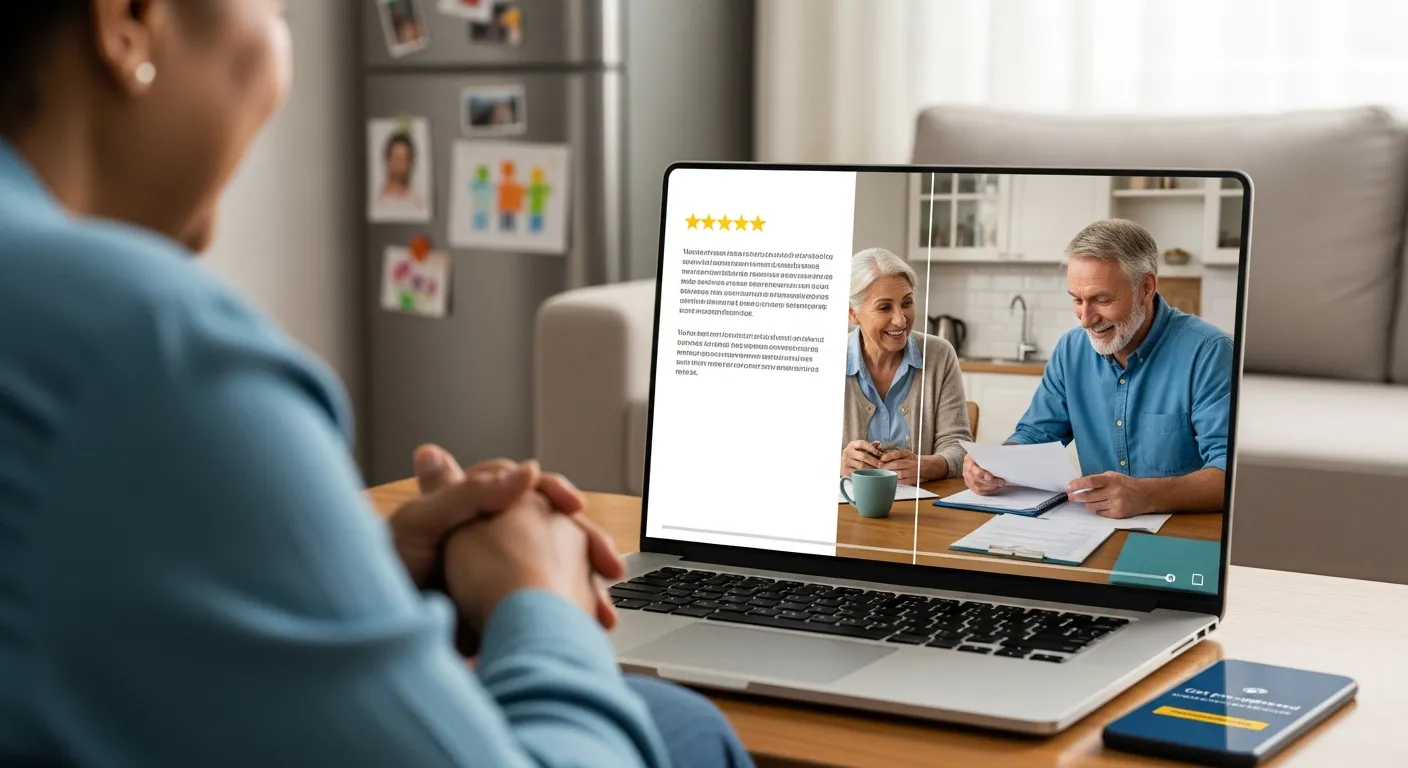
When Each Testimonial Type Makes Sense: Contextual Use-Cases for Video vs Written Reviews
So should you burn your text reviews and go all‑in on video?
Nope. That’d be like throwing out your GPS because your car also has a windshield.
Video and written reviews do different jobs. When you use them at the right moments, they reinforce each other instead of competing.
Awareness stage (top-of-funnel)
At the very top of the funnel, your goal is simple: get noticed and feel human.
This is where short clips shine.
Think:
- A 15–30 second vertical video of a client saying, “I finally stopped dreading my credit card bill.”
- Quick snippets in a social ad where a homeowner says, “We listed on Friday and had three offers by Monday.”
At this stage, you can absolutely pair video with:
- Star ratings in your ad creative
- One‑sentence pull quotes from longer written reviews
Text here is like seasoning, just enough to give context while the video does the emotional work.
Consideration stage (mid-funnel)
Once people know you exist, they start comparing.
You are against the clinic down the road.
You are against the national brokerage.
You are against the “friend of a friend” advisor.
Here, a hybrid approach is your best friend.
- Use longer video testimonials (60–120 seconds) to walk through the story:
- What life looked like before
- Why they hesitated
- What your process was like
- The specific outcome
- Surround those videos with detailed written reviews so visitors can skim for:
- Their specific condition or financial situation
- Their neighborhood or property type
- Their life stage (new family, near retirement, etc.)
Video builds connection and trust.
Text makes it easy to check, “Do they help people like me?”
This is also a smart place to add mini case studies, short blurbs like:
“Self‑employed designer, 2 years in business → secured first home with 5% down after lender said no elsewhere.”
Text and video together cover both heart and head.
Decision stage (bottom-of-funnel)
The bottom of the funnel is where people hesitate.
They’ve filled out half the form, they’ve added the consult to their calendar tab… and then they think:
- “What if this is a waste of time?”
- “What if I’m pressured into something?”
- “What if there’s a hidden fee or risk?”
This is where one or two perfectly chosen video testimonials can do more than a dozen generic five‑star blurbs.
You want faces and stories that mirror your buyer as closely as possible:
- Same type of property or price range
- Similar health concern or financial goal
- Same level of skepticism
Put those videos right next to your primary call‑to‑action on pricing, booking, or application pages.
Then keep a layer of text reviews visible close by:
- A star rating summary
- A short scannable list of recent comments
- maybe a “Read all reviews” button
The video says, “This worked for someone just like you.”
The text says, “And it wasn’t a fluke.”
The Balanced Playbook for Social Proof in 2025
If you’re juggling a business, a family, and a calendar that looks like a game of Tetris, you don’t need another complicated “funnel hack.”
You need a simple, realistic plan.
Here’s a practical playbook you can run with.
1. Make a video of the hero where trust matters most.
Pick 2–3 key pages (usually your homepage, core service page, and booking/application page) and add one strong, under‑two‑minute testimonial video to each.
2. Keep building written reviews for scale and SEO.
Ask happy clients for a quick Google review, Zillow rating, Healthgrades comment, wherever your audience checks you. Use snippets of those reviews under your videos and in comparison sections.
3. Match stories to segments.
If you serve both retirees and first‑time buyers, don’t show them the same proof. Curate playlists or sections: “For new buyers,” “For growing families,” “For business owners,” “For chronic pain patients,” and so on.
4. Systematize the ask.
Don’t wait for unicorn clients who email, “Can I leave you a testimonial?”
Build it into your process:
- After a successful closing, discharge, or milestone, send a short email: “Would you be open to sharing your story in a quick video? It helps other people in your situation feel less nervous.”
- Make it easy: give them a simple link or a 3‑question prompt.
5. Design for phones first.
Most people will discover your testimonials on a 6‑inch screen.
That means:
- Vertical or square formats for social and email
- Big, clear captions (a lot of folks watch on mute)
- The most powerful quote in the first 3–5 seconds
6. Keep testing placements.
Move your videos higher or lower on the page, swap which story you feature on which service, and watch what happens to form fills, calls, or booked consults.
Your audience will tell you, in numbers, what they trust most.
If you remember nothing else, remember this:
- Written reviews are the crowd noise, significant, reassuring, and still part of the game.
- Video testimonials are the star witness, the person who walks up to the mic, looks your buyer in the eye, and says, “Here’s exactly how this turned out for me.”
You don’t have to produce a Netflix special.
You just have to capture real people, telling real stories, in a format your future clients believe.
Start by picking one client whose journey you’re proud of. Schedule 20 minutes. Hit record. Ask them what life looked like before you met, what changed, and what life looks like now.
That one video can work harder for your business than a hundred anonymous five‑star blurbs, and it might be the simplest marketing move you make all year.
Leverage Video Testimonials in your Business, Start with Share One ➡️
Frequently Asked Questions
Why do video testimonials convert better than written reviews?
Video testimonials feel like real conversations. Viewers see faces, hear tone, and read body language, which activates emotional responses and trust. Studies show visitors who watch testimonial videos are more likely to convert, and landing pages can see conversion lifts of up to 80%.
When should I use video testimonials vs written reviews on my website?
Use video testimonials on high-intent pages—your homepage, core service pages, and booking or application forms—where trust matters most. Use written reviews for scale and quick proof: Google or Zillow listings, scannable quotes around videos, and comparison sections where prospects search for situations similar to their own.
How do video testimonials impact SEO compared with written reviews?
Video testimonials keep visitors on your pages longer and boost engagement, which are positive behavioral signals for SEO. People are more likely to watch a 30–60 second video than read long review blocks, and they retain about 95% of a video’s message, helping your brand stay top of mind when they’re ready to act.
Are written reviews still important if I focus on video testimonials?
Yes. Think of written reviews as supporting evidence and video testimonials as your star witness. Written reviews help with volume, ratings, and keyword-rich content across platforms like Google, Zillow, and Healthgrades. Pair them with videos so prospects get both emotional reassurance and fast, scannable proof that you help people like them.
What’s the best way to record video testimonials without a big budget?
A modern smartphone, a simple clip-on mic, and natural window light are usually enough. Use an interview-style approach with open questions, let customers speak in their own words, and keep videos under two minutes. Light editing that preserves small pauses or laughs often feels more authentic than heavily scripted, overproduced footage.
Are there legal or privacy concerns with video testimonials vs written reviews?
Yes. Always get clear, written consent before publishing a video testimonial, especially in regulated fields like healthcare or finance. Avoid sharing sensitive personal or financial details, follow any industry-specific compliance rules (like HIPAA in the U.S.), and allow clients to review how their name, image, and story will be used.