Video Testimonials Cost: What’s Worth Paying For?
Plan smarter marketing budgets by weighing video testimonials cost against the value of authentic, high-converting customer videos.
If you knew that adding customer videos to your site could make visitors more likely to convert, how fast would you find room in your budget for them?
You’re in crowded markets, healthcare, finance, and real estate, where everyone promises “trust” and “care,” but buyers believe people who look and sound like them, not another polished tagline. Short, authentic clips from real clients don’t just build confidence: they boost dwell time on your pages, help your SEO, and give your sales team proof they can literally hit play on.
In this guide, you’ll see what video testimonial cost really covers, where you can save, when it’s worth paying more, and how to translate production dollars into lower CAC, higher-quality leads, and better long-term revenue, without turning your marketing budget into a black hole.
Key Takeaways
- Understanding video testimonial cost means looking beyond the invoice to what you actually get: strategy, rights, and deliverables that move conversion, CAC, and revenue.
- Most professional testimonial videos for small and mid-sized service businesses range from about $500 to $5,000 per finished video, with DIY/remote at the low end and cinematic multi-location shoots at the high end.
- Your video testimonial cost is driven by factors like interviewer quality, in-person vs. remote capture, editing complexity, number of deliverables, and usage rights for web, ads, or broadcast.
- For many healthcare, finance, and real estate brands, the best cost-to-ROI balance sits in the $2,500–$5,000 mid-tier, where you get strong interviewing, polished editing, and multiple formats for site, email, and ads.
- To avoid hidden expenses on testimonial projects, always clarify revisions, music and stock licensing, extra social cuts, travel, and where you’re legally allowed to use each video.
Why Understanding “Video Testimonial Cost” Matters
Let’s start with the question that’s probably sitting in the back of your mind right now:
“How much should I really be paying for this?”
Not just, What’s the invoice? But what_ am I getting for that number?_
When you understand how pricing works for customer videos, a few really important things happen:
- You stop getting surprised by “extras” like licensing or endless revision fees.
- You can compare providers on value, not just who emailed the lowest quote.
- You can plan testimonial content like a strategic asset, not a one-off nice-to-have.
In service businesses, especially healthcare clinics, financial advisors, and real estate teams, trust is your entire funnel. If strangers don’t feel safe with you, they don’t book the appointment, schedule the consultation, or request the showing.
That’s why cost without context is dangerous.
Two videos that both cost $2,500 can be wildly different under the hood:
- One might include a rushed remote interview, a basic edit, and no real thought about where it lives on your site.
- The other might include strategy, scripting support, multiple social cutdowns, captions, and the usage rights you need to run it in ads for a year.
The dollars look the same on paper, but the ROI? Completely different.
So as we walk through numbers, think less “Is this cheap or expensive?” and more “What does this do to my conversion rate, CAC, and pipeline?” That’s the lens that makes budget decisions much easier and a lot less stressful.
Average Cost of Video Testimonials Today
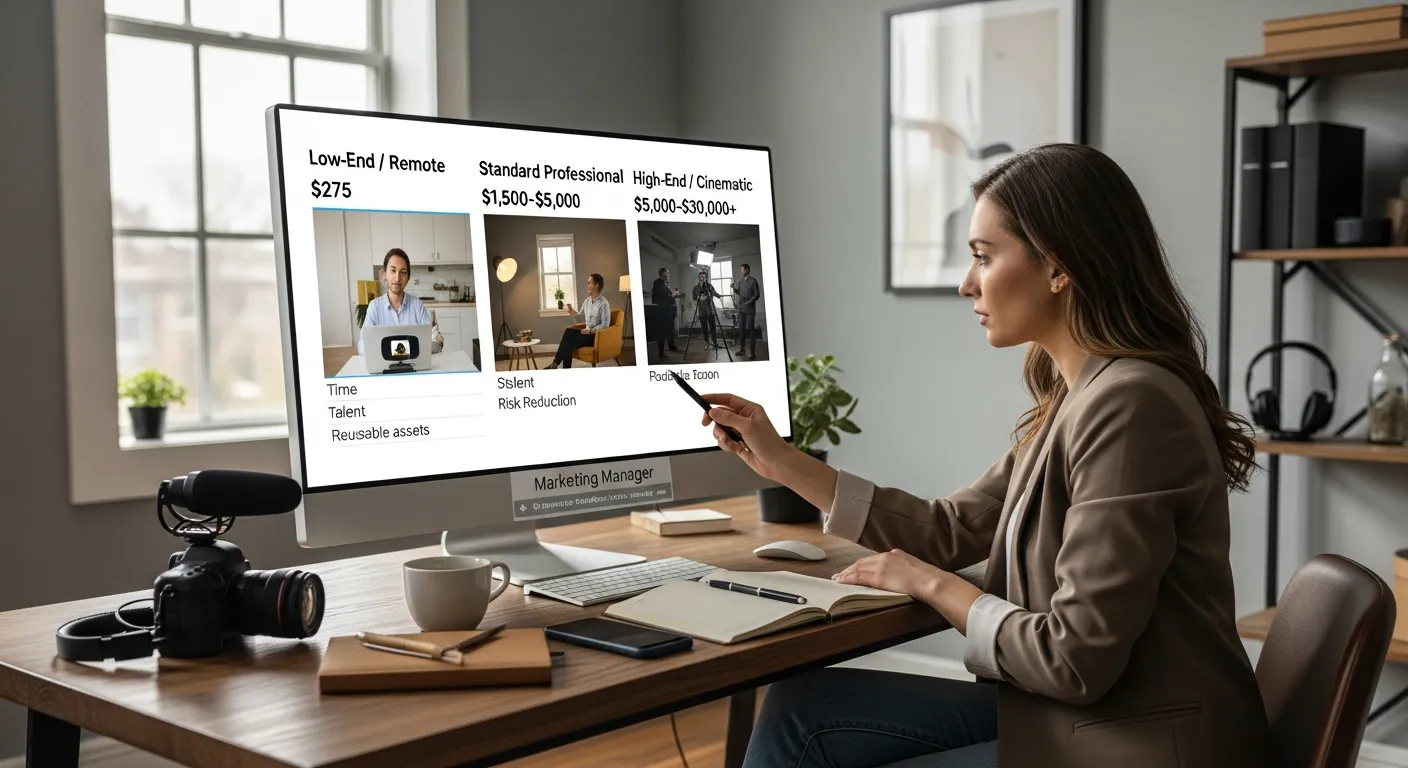
You’ll see price tags for testimonial work all over the map, from a few hundred bucks to “wait, is that a car payment or a video?”
For small and mid-sized service businesses, most professional testimonial videos land somewhere between $500 and $5,000 per finished video, depending on quality, length, and deliverables.
Zooming out across the industry:
- Remote / talking-head clips that are recorded over a link and lightly edited can be as low as $275 per video.
- Basic on-brand testimonials with simple editing and minimal B-roll often run $1,500–$2,500.
- Mid-range productions are commonly priced $400–$2,000 per finished minute, based on complexity.
- High-end, on-location stories (multiple interviews, lots of B-roll, a whole crew) can go from $5,000 up to $30,000+ for a longer piece.
If that range feels wide, you’re not crazy.
The spread exists because you’re not just paying for minutes of footage, you’re paying for time, talent, risk reduction, and reusable assets.
Let’s pull the curtain back on what those numbers include.
Industry ranges from low-end to cinematic
Think of testimonial costs in three broad bands.
1. Low-end / DIY / Remote
This is the scrappy stuff. Tools where your client records on their phone or laptop, maybe guided by prompts. You (or a basic editor) clean it up afterward.
- Cost: free up to a few hundred dollars per video (or $30–$100/month for software). Some providers offering guided remote interviews start around $275 per finished clip.
- Look & feel: clean but simple. Think Zoom call with better framing and some branding.
- Best when: you need volume, social snippets, or are just testing whether visitor videos convert for your audience.
2. Mid-range / Standard Professional
This is what most local practices and growing firms invest in.
- Cost: often $1,500–$5,000 per video, or $400–$2,000 per finished minute for longer case-study style pieces.
- Look & feel: nicely lit interviews, decent B-roll, clean audio, lower-thirds, your logo, maybe a couple of social cutdowns.
- Best when: you want polished but not cinematic, something that looks trustworthy on a homepage, in email campaigns, and in retargeting ads.
3. High-end / Cinematic
This is where your video starts to feel like a mini-documentary.
- Cost:$5,000–$30,000+ per project.
- Look & feel: multiple locations, multiple clients or doctors/advisors/agents on camera, storyboarded B-roll, advanced color and graphics.
- Best when: you’re running large campaigns, you’re a regional or national brand, or you want a flagship story that anchors your brand for years.
What a “standard testimonial package” includes
When a vendor says, “Our package is $2,500,” what’s usually in that box?
Most “standard” offers include some version of:
- A short planning call and question outline.
- One interview (on-site or remote).
- Basic lighting and sound on the day, or tech support if it’s remote.
- A primary edit (usually 60–120 seconds, which happens to line up with research that shows testimonials under two minutes tend to perform best).
- Simple titles and your logo.
- Light sound mix and color correction.
- Maybe one social-friendly cut (like a 15–30 second version).
- One or two revision rounds.
What’s usuallynot included in lower-cost packages:
- Tons of B-roll shot on location.
- Advanced motion graphics or animated explainers.
- Multiple finished versions for different audiences or funnels.
- Extended licensing (for example, using the video in paid ads for years).
That’s where many people get tripped up on price; they compare a bare-bones “standard” package to a fully loaded one and assume someone’s just overcharging.
They’re not always overcharging. You’re just looking at different levels of work and ownership.
What Affects Your Price?
Why does your friend’s real estate group say they got a testimonial day for $1,200, while your quote for a single patient story is $4,000?
Same idea, same country, totally different math. Let’s break down the big levers.
Interviewer quality & Talent/crew fees
The people in the room (or on Zoom) change everything.
- A junior videographer with a camera and a light is cheaper.
- An experienced director-interviewer who knows how to make a nervous client relax and talk like a human? That’s more.
And it’s not just the person holding the camera.
On bigger shoots, you’re paying for:
- Camera operator
- Sound engineer
- Producer or director
- Sometimes makeup or a small support crew
In healthcare and finance, this matters more than you think.
A dentist asking “So, how was the service?” on an iPhone usually gets stiff, one-word answers.
A pro interviewer who knows how to ask, “Can you tell me about the moment you realized this practice was different from the others?” pulls out vivid, emotional stories, the stuff that converts.
Using your real customers instead of hired actors usually reduces cost and increases trust. But it takes skill to guide them.
Editing complexity & Post-production level
Post-production is where raw footage becomes something you’re proud to put on your homepage.
And it’s often 25–40% of the total budget.
Here’s what changes the price:
- Simple cut vs. multi-layer edit with lots of B-roll
- Basic color and sound vs. detailed grading and mixing
- No on-screen text vs. animated lower-thirds, captions, and callouts
- One finished version vs. a whole battery of social cuts, ad versions, vertical formats
A 75-second testimonial with one camera angle and almost no B-roll is very fast (and cheaper) to edit.
That same 75 seconds built from multiple angles, clinic shots, chart overlays, and text highlights takes way longer, and looks way better.
You’re not just buying minutes of video. You’re buying how watchable and believable that video feels.
Remote vs In-Person Shoot (filming method)
This is one of the biggest cost levers you can control.
Remote / Self-recorded or guided capture
- Usually the most affordable option.
- Your client records from home or office (phone or laptop), often with a guided link.
- A production team cleans it up in post.
Perfect when:
- Your clients are scattered across states.
- You want to film 10+ customers without flights and hotel bills.
On-site / In-person
- A crew shows up at your practice, office, or a client’s location.
- You pay for travel, gear, setup time, breakdown, and often a full day rate, not just the minutes recorded.
Worth it when:
- Your space is part of the story (a warm waiting room, high-end financial office, properties you’ve sold).
- You’re creating cornerstone videos that will live on your site for years.
Remote keeps costs down and volume up. In-person elevates production value and connection, at a higher price.
Revisions, deliverables & Usage Rights / Licensing
Here’s where a lot of “cheap” projects suddenly…aren’t.
Revisions
Most packages limit you to 1–2 rounds. Need more tweaks? That’s often billed hourly.
Deliverables
Every extra version takes time:
- Vertical edits for Reels/TikTok
- Square cuts for paid social
- Short snippets for email or retargeting ads
- Subtitled versions
Some vendors bundle a couple of social cuts; others charge à la carte.
Usage rights/licensing
This one gets overlooked a lot.
- Want to run the video only on your website? Usually standard.
- Want to put it in Facebook or YouTube ads for 18 months? That might need extended usage rights.
- Want broadcast, OTT, or large-scale campaigns? That may require music, footage, and talent buyouts.
If you skip this conversation up front, you can end up paying again when you’re finally ready to scale an ad that’s working.
So when you look at any quote, ask yourself: “What are we filming, what are we getting back, and where am I legally allowed to use it?”

Cost vs ROI: What You Actually Get Back
Let’s be real: if a video doesn’t move the numbers that matter, it doesn’t matter. The ROI is what measures if spending on your video testimonials is cost-effective.
You’re not buying art for your waiting room; you’re buying trust, shorter sales cycles, and more qualified leads.
Typical ROI benchmarks & conversion uplift
Industry studies on marketing videos show something important: when people see real customers on video, they’re far more likely to convert than when they see static reviews.
In practice, here’s what that can look like:
- A financial planner’s “Book a Call” page goes from 3% to 4% conversions after adding two 90-second client stories near the form.
- A dental practice’s Invisalign landing page adds a 60-second patient story at the top, suddenly more visitors scroll, more click through, and more request consults.
On paper, that’s “just” a few percentage points.
But when you multiply that by every visitor, every month, the lift stacks up fast.
And because testimonial clips are re-usable, on your website, in email sequences, in retargeting, on your Google Business Profile, you keep getting the benefit long after the shoot is paid for.
Impact on Customer Acquisition Cost (CAC) & Lifetime Value (LTV)
Here’s where cost finally starts to feel sane.
Say you spend $5,000 on a set of testimonials:
- You use them across your homepage, two landing pages, and retargeting ads.
- Your overall conversion rate from click to booked consult nudges from 5% to 6.5%.
Your ad spend didn’t change. Your traffic didn’t change.
Your CAC just dropped because you’re closing more people with the same spend.
On the flip side, better-fit clients tend to:
- Stay with you longer (therapy, wealth management, primary care).
- Spend more over time (adding services, referring family, moving up tiers).
- Leave better reviews, fueling the next wave of trust.
That’s your LTV creeping up.
So while a $3,000 or $8,000 line item can sting in the moment, the payback often doesn’t live in one month; it lives across 6–18 months of improved conversion and retention.
Real-world Examples (what clients gained)
Let’s walk through a few case studies (details anonymized, patterns very real).
1. Small Wealth Advisory Firm – Midwest
They shot three 2-minute client stories: a young family, a nearing-retirement couple, and a small business owner.
- Cost: about $6,500 for the set (mid-range, on-location shoot + edits and social cuts).
- Placement: homepage hero section, “Why Us” page, and a nurture email sequence.
- Result (6 months):
- Discovery call bookings up ~22%.
- Fewer “I’m just shopping around” calls: more “I saw your client Tim talk about exactly what I’m dealing with.”
2. Multi-location Dental Practice – Southeast
They added four short patient stories focused on fear, trust, and painless procedures.
- Cost: around $4,000 (mix of remote and on-site, plus captions and social clips).
- Placement: specific treatment pages + retargeting video ads.
- Result (9 months):
- Higher acceptance rate on treatment plans discussed in consults.
- More inbound leads saying, “I saw your patient talk about being terrified of dentists, that’s me.”
3. Boutique Real Estate Team – Coastal City
They filmed seller and buyer stories around speed, communication, and above-asking-price results.
- Cost: about $3,500 for one shoot day and multiple edited clips.
- Placement: listing presentations, email follow-ups, and social ads.
- Result (1 year):
- Higher close rate in listing appointments.
- More referrals, often opened by, “We watched a couple of your client videos: we’d like to chat.”
None of these businesses bought videos because they like cameras.
They bought stories that reduced friction at each point where a nervous human has to say, “Okay. I trust you.”
Pricing Tiers Explained
To keep this grounded, it helps to translate everything into straightforward tiers.
You’ll see different labels, Basic, Pro, and Enterprise, but underneath, most offers fit into a familiar pattern.
Basic / Mid-Tier / Enterprise: What do they mean
Here’s a useful mental model:
TierTypical Budget Range (USD)Best for
Basic$300–$800 (DIY/remote) or $1,500–$2,500 (agency basic)Quick, simple talking-head clips for social proof, early tests, and smaller budgets.
Mid-Tier / Standard$2,500–$5,000 per projectPolished interview-style stories with some B-roll, better editing, and a few extra deliverables.
Enterprise / Premium$5,000–$30,000+ High-production pieces for campaigns, big brands, or long-term flagship content.
Basic is where you lean more on authenticity than aesthetics.
You might use smartphones, remote capture tools, or lightweight crews. The key here? Good audio, a clear story, and a length under two minutes.
This is perfect when you’re just proving to yourself, “Yes, our clients will do this, and yes, it moves numbers.”
Mid-tier is where most ambitious practices and firms should live.
You get:
- Real planning helps
- On-brand visuals
- Enough edits to slice content for multiple channels
This price band usually offers the best cost-to-ROI ratio.
Enterprise is overkill for some, essential for others.
If you’re a regional healthcare system, a large brokerage, or a financial brand with national campaigns, these pieces become your flagship trust assets, on your homepage, in TV/OTT, on stage at events.
Hidden Costs Other Providers Often Add
Here’s the stuff that quietly inflates budgets, and how to protect yourself.
1. Revisions beyond 1–2 rounds
If the contract says “includes one round of revisions,” that second “small tweak” isn’t minor to them. Ask what additional rounds cost.
2. Licensing for music, stock, and fonts
That beautiful cinematic track? It probably isn’t free. Clarify whether your fee covers:
- Commercial use
- Duration (1 year vs. perpetual)
- Platforms (web only vs. ads vs. broadcast)
3. Add-on deliverables
Vertical cuts, square versions, multilingual subtitles, they’re all instrumental. But they all take time.
Ask vendors to quote these up front, so you’re not tacking on surprise costs at the end.
4. Travel and location fees
Flying a crew, renting a studio, or even securing certain offices as locations can add serious dollars.
If you’re on a tight budget, you can often save by:
- Filming multiple clients in one location and on one day.
- Choosing remote capture for out-of-town clients.
A good partner will walk you through all this in plain English, not bury it in line-item legalese.
The Share One Difference: Pricing Model That Makes Sense
Here’s where Share One’s approach fits into everything you’ve just read.
You don’t need a mystery box. You need to know precisely what you’re paying for, and how to dial things up or down without losing authenticity.
Why a transparent, component-based model is efficient
A component-based model breaks the process into clear building blocks:
- Strategy & prep
- Capture (remote or in-person)
- Editing & post
- Deliverables (how many versions, what formats)
- Licensing & rights
You see every piece. No “trust us, it’s in there.”
Why that’s a win for you:
- You can start lean, maybe remote-only, a couple of edits, then scale to bigger shoots once you prove ROI.
- You don’t pay for things you don’t need, like a motion graphics package when all you need are clean, honest faces and good captions.
- You can map cost directly to outcomes: “If this set of videos lifts our booked-consult conversion by even 15%, this line item pays for itself in X months.”
For a time-strapped founder or practice owner, that clarity is gold.
What our model would guarantee & include
Share One is built around one idea: By Humans, For Humans™.
That shows up in the pricing and the process.
While specifics can change with your scope, a typical Share One project is built to guarantee:
- Clear cost breakdown
You’ll see separate line items for pre-production, filming (remote or in-person), editing, and licensing. No “oh, that’s extra” at the eleventh hour.
- Tiered packages that match growth stages
- Basic / Remote-first: guided invitations, unscripted client stories recorded from anywhere, professional polishing, and a couple of social cuts.
- Standard / Hybrid: strategy call, curated questions, a mix of remote and on-location capture, more robust edits, and multiple formats (horizontal + vertical with captions).
- Premium / Enterprise: deeper story strategy, multi-location filming, multiple client stories in one narrative, ad-ready variants, and long-term licensing.
- Transparent usage rights
You’ll know exactly where you can use each video, site, email, social, ads, and for how long. That lets you plan campaigns with confidence.
- Human-first interviewing
No stiff scripts. Your customers get gentle prompts that make it feel like a conversation, not a commercial. Those tiny stumbles and laughs? They’re often what makes people lean in.
- Conversion-focused guidance
You’ll get help choosing where to place each video, like right above your “Book a Call” button or inside your follow-up emails, so you’re not just collecting pretty clips, you’re shifting behavior.
Picture this:
You’re “David,” the financial advisor in the suburbs, finally ready to stop relying on word-of-mouth alone.
In a few weeks, you will have:
- Three 90-second stories from real clients talking about paying off debt, finally feeling organized, or retiring with confidence.
- Short clips from those same videos automatically repurposed for social.
- Captions baked in so they work on silent autoplay.
- Clear rights to run the best-performing clip in retargeting ads for the following year.
You didn’t chase clients for footage, fight with editing software, or interpret legal language about rights. You just show up, approve, and plug these stories into your funnel.
Final Thoughts: What You Should Budget and What You Should Expect
Let’s pull this into something you can use in your planning doc.
If you’re a smaller practice or firm testing the waters, setting aside $300–$800 per video with DIY/remote tools, or $1,500–$2,500 for a basic agency-style package, can give you very real, very usable customer stories, especially if you keep them under two minutes and focus on honest, unscripted moments.
If you’re ready for a more polished, multi-channel approach, budgeting $2,500–$5,000 per project is the sweet spot for many healthcare, finance, and real estate brands: enough for great interviewing, strong editing, and a few extra versions you can use across your site, email, and ads.
If you’re running bigger campaigns or building flagship stories that define your brand, expect $5,000–$30,000+ for premium, multi-client, multi-location work, and treat those videos as long-term assets, not one-off expenses.
Whatever level you choose, insist on clarity: what’s included, how many revision rounds, where you can use the videos, and what formats you’re getting.
And if you want a partner who lives and breathes human-first stories, not just production days, Share One is built for precisely this: turning real client wins into persuasive proof that lowers your CAC, boosts lead quality, and helps people believe in what’s possible with you.
When you’re ready to start turning the trust you’ve already earned into stories that keep working for you long after the camera is off, get in touch with Share One.
Start with Share One ➡️
Frequently Asked Questions
What is the average video testimonial cost for small and mid-sized businesses?
For most small and mid-sized service businesses in the U.S., professional video testimonial cost typically ranges from $500 to $5,000 per finished video. Simpler remote talking-head clips can start around $275, while more polished, on-location testimonial stories with B-roll and multiple edits land toward the higher end.
Why does video testimonial cost vary so much between providers?
Video testimonial pricing varies because you’re not just paying for minutes of footage. Cost is driven by interviewer and crew experience, filming method (remote vs. on-site), editing complexity, number of deliverables, and licensing/usage rights. Two videos may both cost $2,500 but deliver very different strategy, quality, and ROI.
How can I reduce my video testimonial cost without hurting results?
To keep video testimonial costs down, choose remote or guided self-recording instead of full on-site crews, batch multiple client interviews in one session, keep videos under two minutes, and limit revision rounds. Focus your budget on strong interviewing, clear audio, captions, and a few strategic edits you can repurpose across channels.
Are video testimonials worth the cost for healthcare, finance, or real estate?
Yes. For trust-based services like healthcare, financial advising, and real estate, strong video testimonials often lift conversion rates 15–40% on key pages. That means more booked consults and closed deals from the same traffic, lowering customer acquisition cost (CAC) and improving lifetime value, often paying back the investment within months.
Should I use DIY tools or hire a professional for video testimonials?
DIY or low-cost remote tools work well for early tests, social snippets, and gathering volume on a tight budget. Hiring a professional makes sense when you need on-brand lighting, strong interviewing, strategic story structure, and multiple formats for your website, email, and ads—especially for flagship or long-term testimonial assets.
What should be included in a standard video testimonial package?
A standard package around the mid-range of video testimonial cost usually includes a planning call, question outline, one client interview (remote or on-site), basic lighting and sound, a 60–120 second edit, simple titles and logo, light color/sound correction, one or two social cuts, and 1–2 rounds of revisions—with licensing defined upfront.