How Fast Do Video Testimonials Work
How fast do video testimonials work? See real timelines by industry, what speeds results up, and a 24-hour playbook to start getting leads faster.
If you could flip a switch and make strangers trust you more, how much easier would it be to book consults, close retainers, or sell that high-ticket package? Website visitors who watch customer stories are dramatically more likely to convert, and because those clips keep people on your site longer, they quietly help your SEO at the same time.
The real question on your mind, though, isn’t if they work; it’s how fast dovideo testimonials work and when you’ll see actual leads, booked calls, or revenue from them. You’re juggling patients, closings, client calls: you don’t have six months to “wait and see,” so let’s walk through realistic timelines, what speeds things up, what slows them down, and a simple playbook you can roll out in a day.
You’ll see real-world ranges (days, not just vague “soon”), plus practical tips you can plug right into your funnel, no Hollywood studio required.
Key Takeaways
- If you already have traffic, you can typically start seeing directional impact from video testimonials within 1–2 weeks and solid, data-backed results in 30–90 days.
- In SaaS, strong video testimonials placed near key CTAs can lift trial or demo conversions in as little as 3–7 days, while coaches, consultants, and high-ticket offers usually see clearer gains over 2–4 months.
- Medical and other high-consideration services tend to experience slower but deeper results, with visible impact in 2–4 weeks and stronger data emerging over 3–6 months as prospects move through longer buying cycles.
- How fast video testimonials work depends heavily on strategic placement near CTAs, clear audio, concise editing, and emotionally specific stories that address real objections and show tangible outcomes.
- Results slow down or stall when testimonials are buried on low-traffic pages, feel over-produced or generic, or are used to mask a weak offer instead of amplifying an already strong client experience.
Why Video Testimonials Accelerate Buyer Confidence and Funnel Velocity
Picture your ideal buyer.
They’ve got ten tabs open, three kids or coworkers interrupting them, and a decision to make that feels risky, choosing a new doctor, a financial advisor, or a real estate pro who’ll handle a six‑figure deal.
In that chaos, a warm, confident face on video saying, “I was nervous too, but here’s what happened” slices through the noise.
That’s the magic.
Under the hood, authentic video testimonials are doing three big psychological jobs for you:
- Social proof on steroids. People trust other people way more than they trust your headline. 9 out of 10 people say they trust what a customer says about a business more than what that business says about itself. Seeing someone like them on camera hits the “people like me” trigger instantly.
- Trust transfer. When a calm, happy client talks about how you solved their problem, a little of their credibility rubs off on you. It’s like borrowing their reputation for 60–90 seconds.
- Anxiety reduction. High‑consideration buys are full of silent questions: “Will this hurt? Is this legit? Am I wasting money?” A good video testimonial answers those out loud, which shrinks the perceived risk and speeds up the “okay, let’s do this” moment.
On top of that, video keeps people on your site longer.
More time on page + higher engagement = better SEO signals, which can nudge your rankings up and feed even more traffic into that faster‑moving funnel.
So yes, the format matters, but the speed comes from how quickly you can deliver believable proof, right at the moment someone’s cursor is hovering near your Call button.
Typical Timeline (By Industry)
Here’s the part you really care about: when you’ll see this stuff move the needle.
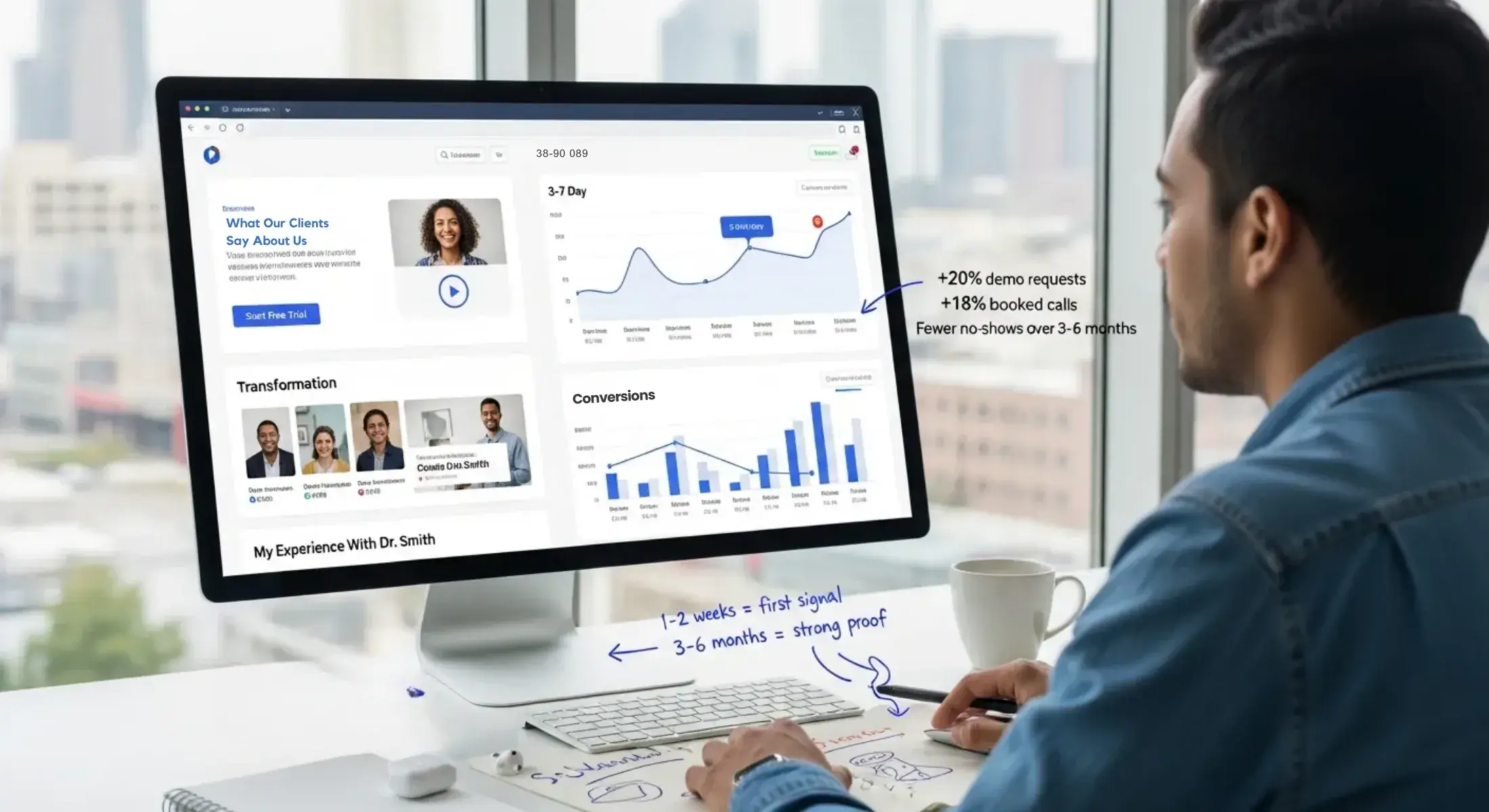
The short answer: if you already have traffic, you usually start seeing directional impact within 1–2 weeks, and clearer, data‑backed results within 30–90 days.
The longer answer depends on how big the decision is for your buyer.
SaaS
If you’re in software, especially self‑serve or demo‑driven SaaS, your sales cycles are fast.
Prospects land on a pricing page, scan features for about 15 seconds, and decide whether to start a trial or book a demo.
Drop a strong video testimonial next to your primary CTA, and you can see:
- First signals: in 3–7 days (higher click‑through on the trial/demo button, longer time on page).
- Measurable lift: in 2–4 weeks, once you’ve had enough visitors for a decent A/B test.
I’ve seen a lean dev‑tools startup bump demo requests by around 20% just by adding two 60‑second customer stories near the “Book a Call” button, no redesign, no fancy funnel work.
Coaches / Consultants
If you sell transformation, health coaching, leadership consulting, or done‑for‑you marketing, the trust bar is even higher.
People aren’t buying a dashboard: they’re buying a future version of themselves.
Here, emotionally honest video testimonials can start nudging behavior in 1–2 weeks (more people watching your full sales video, more calendar views), with clearer conversion lifts in 2–4 months, especially on high‑ticket offers.
A pattern I see a lot:
- Add 3–4 short client stories to a sales page or webinar replay page.
- On the next launch, booked calls and applications jump 15–25%, without adding more traffic.
Medical / High-Consideration Services
If you’re in healthcare, dentistry, or anything that touches safety and long‑term wellbeing, moves are slower but deeper.
Your prospects might lurk for weeks.
They’ll look you up on Google, stalk your reviews, text a friend, and only then fill out a form.
Video testimonials here are like a steady drip of reassurance, not a one‑shot adrenaline hit.
Typical pattern:
- First impact: subtle but visible in 2–4 weeks, more calls, more form fills, fewer “no‑shows.”
- Solid data: over 3–6 months, as more prospective patients or clients move through that longer journey, and you track where they first saw you.
If your practice already ranks decently, a bank of 5–8 authentic videos can genuinely become the quiet engine behind a calendar that never feels empty again.
Want to know how Share One impacts different industries? Take a peek at our Video Testimonials By Industry guide.
What Speeds Up Results
You can absolutely drag this out for months… or you can set things up so your video testimonials start working almost immediately.
Three levers matter most.
Proper Placement
Think of your testimonials like espresso shots, not background decor.
You want them right where the decision happens:
- Above or beside the primary CTA on your landing page.
- Near pricing tables or membership options.
- On checkout pages for digital products or SaaS trials.
- In key email sequences, especially welcome, abandoned cart, and “book a consult” nudges.
A quick test for yourself: open your main money page on your phone. If you have to scroll more than a thumb‑length to see a human face talking about results, you’re hiding your best salesperson.
Editing Style & Video Quality
You don’t need a $5,000 shoot.
You do need something that:
- Sounds clear (people forgive average visuals, not crunchy audio).
- Gets to the good stuff in the first 3–5 seconds.
- Stays under 90 seconds for most uses.
Think of it like a mini story arc:
“Before I worked with [YOU], I was…” → “What surprised me was…” → “Now I…” (plus a number if they have it).
A simple phone video, shot near a window, held steady or on a $25 tripod, can outperform a glossy, over‑produced brand film, because it feels like a real person, not a commercial.
Emotional Clarity & Objection Coverage
This is the quiet cheat code.
Fast‑working video testimonials don’t just say, “They’re great.”
They say, “I was worried about X, and here’s exactly how they solved it.”
For a financial planner, that might be fees or trust.
For a plastic surgeon, it might be pain, scars, or recovery time.
For a real estate agent, it might be bidding wars or negotiation.
When you invite clients to record, give them a light structure, not a script:
- What were you nervous about before you said yes?
- What changed for you after working together?
- What specific results did you see? (time saved, money made, pain reduced)
Hit those three beats, and your video becomes a 24/7 objection‑handler.
That’s where the speed comes from.
What Slows Down Results
If you’ve ever thought, “We tried video testimonials once: nothing happened,” chances are the issue wasn’t the concept; it was the execution.
Here’s what usually gums up the works.
Poor Distribution or Placement
You record a beautiful story… and then bury it on a lonely “Testimonials” page no one clicks.
Result: crickets.
If your videos aren’t within one scroll of a call‑to‑action, or you never mention them in emails, they’re invisible.
Think of them like prime shelf space at a grocery store, you want eye‑level, not bottom‑row behind the mop bucket.
Low-Quality Footage or Poor Storytelling
Blurry camera. Echoey office. Five‑minute ramble about how “the team was nice.”
Not only does that fail to help, but it can also hurt you.
Your viewer subconsciously connects sloppy video with sloppy service.
Keep things:
- Short (60–90 seconds for core funnel spots).
- Focused on one clear win.
- Shot in a quiet, well‑lit place where your client’s face and voice feel close and clear.
Missing Objection Coverage or Relevance
Generic praise like, “They’re amazing, highly recommend,” is fine for Google Reviews.
Inside a serious buying decision, it’s background noise.
You want relatable specifics:
- A busy mom talking about how you scheduled around her kids.
- A first‑time homebuyer describing how you explained every step.
- A nervous dental patient explaining how the staff handled their fear.
If your visitor doesn’t see themselves in your testimonials, they file it under: “Good for them, not sure about me.”
That slows everything down.

Fast Deployment Playbook
Let’s say you want this up and running this week, not “Q3 when we redo the brand.”
Here’s a simple, scrappy playbook you can follow between appointments.
24-Hour Implementation Checklist
Day 1, coffee in hand:
- Pick your money page. Usually, your main landing page, services page, or pricing page.
- Choose 1–2 dream clients. The ones who already sing your praises and match your ideal new buyer.
- Send a quick ask email. Keep it casual: “Would you be open to a 60‑second video about your experience? I’ll give you three simple questions so it’s easy.”
- Give them the mini‑script:
- What problem were you dealing with?
- What made you choose us?
- What’s life like now? Any specific results?
- Have them record on their phone. Vertical is fine; most of your viewers are on mobile anyway.
- Do a light edit. Trim the start/end, add subtitles, and maybe a quick overlay like “Saved $8,400 in fees” or “Closed three deals in 60 days.” Plenty of easy video testimonial tools or basic editors can handle this.
- Embed near your CTA. Above the fold, if possible, or right beside the form/button.
Is it perfect? No. Does it start working? Very often, yes.
30- to 90-Day Review Cadence
Over the next 1–3 months, you’re not just hoping, you’re watching.
Every 30 days, check:
- How did the conversion rate on that page change vs. before the video?
- Are people sticking around longer?
- Do more visitors click through to book or buy?
As you gather data, slowly build a small library, 3 to 6 clips covering different personas and objections.
Rotate them in, test different thumbnails, and try dropping them into:
- Your welcome email.
- A “thinking about it?” follow‑up.
- Retargeting ads.
That’s how you go from “We have a couple of videos” to “These things are quietly cutting my sales cycle in half.”
Contrarian View: When Testimonials Don’t Help (or Can Backfire)
There are situations where slapping video testimonials into your funnel is like putting a fancy spoiler on a car with no engine.
If your offer isn’t dialed in, unclear positioning, inconsistent delivery, or weak product‑market fit, testimonials might just shine a brighter light on the cracks.
You’ll hear things like:
“Results were good… once we finally got started.”
“It was worth it, but the process was confusing.”
Those are clues you need to fix the experience before you amplify it.
Video also backfires when it feels over‑produced and under‑real.
If your customers look like actors, everyone’s in a perfect studio, and the script sounds like a commercial, your viewer’s guard goes up, not down.
You’re better off with a slightly imperfect, honest story than a polished, plastic one.
Use testimonials as an accelerator, not a band‑aid.
When the underlying service is strong, they pour gasoline on the fire. When it’s shaky, they highlight what’s not working.
How to Measure Success: Metrics & Timeline Expectations
To keep this from feeling like guesswork, you’ll want a simple scoreboard.
Here’s what to watch and when.
In the first 7–14 days:
- Time on page: Are people sticking around longer where the video lives?
- Video plays: What percentage of visitors hit play?
- Click‑through to the next step: More clicks on “Book Call,” “Start Trial,” or “Schedule Visit” after watching?
In 30–90 days:
- Conversion rate lift: Compare pages with and without video (or before/after).
- Lead quality: Do the people who watched your video show up more prepared, less price‑sensitive, or further along in their decision?
- Sales cycle length: For real estate, finance, or healthcare, do folks move from first touch to signed paperwork faster?
Longer term, you can look at things like repeat bookings and retention, especially if you’re using recurring services or SaaS.
You don’t need an analytics PhD, just a habit of checking numbers monthly and asking one question:
“Is this story helping more of the right people say yes sooner?”
If the answer is yes, you keep leaning in.
If not, you revisit the story, the placement, or the page you’re pairing it with.
Summary & Realistic Expectations
Here’s the honest, non‑hyped version.
When you plug strong, specific video testimonials into the right spots, you can start feeling the difference in a week or two, and you can usually prove it to yourself with data in 30–90 days.
SaaS and online offers tend to pop first.
Coaches, consultants, and high‑ticket programs feel it over the next couple of months as more warmed‑up leads hit their calendars.
Medical and other high‑stakes services see slower, steadier lifts, but those extra consults are often worth a lot more per client.
If you:
- Ask the right clients.
- Surface real objections and real results.
- Place videos right next to your CTAs.
…you give yourself a shot at meaningful, trackable gains without burning extra hours on content that doesn’t convert.
So the next time you’re staring at an empty slot on your calendar, ask yourself: “Whose story, on video, would help my next best client feel brave enough to click ‘Book’ today?”
Start there, and let those stories start working for you around the clock.
Start Capturing Video Testimonials That Convert➡️
Frequently Asked Questions
How fast do video testimonials work to increase leads and sales?
If you already have traffic, video testimonials can start showing directional impact in about 1–2 weeks and more data-backed results in 30–90 days. Faster sales cycles, like SaaS, see changes in as little as 3–7 days, while high-consideration services may take a few months for full impact.
How fast do video testimonials work for coaches and consultants selling high-ticket offers?
For coaches, consultants, and transformation-focused services, video testimonials usually begin nudging behavior in 1–2 weeks, such as more sales‑video views or calendar visits. Clear, measurable conversion lifts often appear over 2–4 months, especially when 3–4 short client stories are added near key calls-to-action on sales or webinar pages.
How quickly do video testimonials impact SEO and time on page?
Video testimonials keep visitors on your pages longer and increase engagement, which is a positive SEO signal. You can typically see early changes in time on page and engagement metrics within 7–14 days, with more meaningful ranking and organic traffic shifts emerging over a 30–90 day window if traffic is consistent.
Where should video testimonials appear on my website?
Use emotional stories on your homepage or landing pages, outcome-focused videos near product or service details, and proof-driven testimonials on pricing pages, proposal decks, or checkouts. Each placement should reflect the viewer’s level of readiness to act.
What’s the fastest way to start using video testimonials effectively?
Pick your main “money page,” ask 1–2 ideal clients for a 60–90 second phone-recorded video, give them three prompts (problem, why they chose you, specific results), do a light edit with captions, and embed it right next to your primary CTA. This can be done within 24 hours.
How many video testimonials do I need to see real results?
You can start seeing impact with just 1–2 strong, specific video testimonials placed near key CTAs. Over 1–3 months, aim to build a small library of 3–6 clips that cover different personas and objections. Rotating these across pages, emails, and retargeting ads usually compounds results over time.