The High-Converting Video Testimonial Script Template
Capture authentic customer stories with our video testimonial script template. Follow a proven 6-part flow to create high-converting, under-2-minute videos.
If you could turn one happy client into ten new ones, just by asking them a few thoughtful questions on camera, would you make time for that? According to Wyzowl’s 2024 report, 77% of people say a testimonial video has convinced them to buy a product or service, which means those stories your clients are sitting on are unpaid sales reps waiting to go to work. The trick is not having a video; it’s knowing how to guide the conversation so your customer’s story feels real, stays under two minutes, and quietly does the heavy lifting of trust, SEO, and conversions while you’re busy running your business.
Key Takeaways
- A structured video testimonial script template turns random praise into a clear story arc of struggle, turning point, results, and recommendation that actually converts.
- Use the 6-part conversion script: Hook, Tension, Emotional Shift, Breakthrough, Proof, and CTA Story to guide clients into sharing specific, relatable wins in under two minutes.
- Short (60–90 second) video testimonials work best for homepages and social, while longer (2–3 minute) versions are ideal for deeper case studies and high-ticket funnels.
- Rely on conversational prompts instead of memorized lines so clients speak in natural language, show real emotion, and deliver authentic social proof your prospects trust.
- Ask for concrete metrics, time frames, and “skeptic-turned-believer” moments to turn each video testimonial into a reusable, high-converting asset across your entire marketing funnel.
Why Structured Video Testimonials Beat Random Reviews
You’ve probably seen this play out:
Someone sends you a “testimonial video,” and it’s… fine.
They smile, say you’re “great to work with,” toss in a “highly recommend,” and that’s it.
Nice ego boost. Terrible marketing asset.
Random reviews, whether on Google, Zillow, Healthgrades, or a shaky selfie video, usually fall flat because they’re missing a story. There’s no before, no after, and definitely no concrete “here’s what changed for me.”
A structured video story flips that.
Instead of hoping a client magically says the right things, you walk them through a simple arc:
Struggle → Turning point → Results → Recommendation
That arc does three very specific things for you:
- It matches the way your prospects think.
If you’re a financial advisor, real estate broker, or clinic owner, your buyers are quietly asking three questions: “Do you understand my problem? Have you solved it for someone like me? What happened to them?” A structured testimonial answers those in order.
- It locks in emotional trust, not just logic.
Text reviews feel like claims. Seeing a real person’s eyes soften when they describe going from stressed to relieved, that’s a feeling your future clients remember.
- It gives you reusable, high-converting snippets.
When the story follows a pattern, you can easily chop out a 15‑second hook for Instagram, a 30‑second clip for your landing page, and a more extended version for YouTube. No more digging through rambling footage.
Here’s the insider secret a lot of agencies won’t tell you:
You don’t need a fancy studio to get powerful video stories. You just need a repeatable video testimonial script template that nudges your client into telling the right story in their own words.
That’s precisely what you’re about to get.
The 6-Part Conversion Script: Your Template for Maximum Impact

Think of this as a lightweight skeleton you hang your client’s real story on.
No memorized lines. No stiff reading off a teleprompter.
Just you asking smart prompts, and they’re answering like they’re talking to a friend.
Here’s the 6-part structure you’ll use again and again.
1. Hook, Grab Attention Immediately
You’ve got maybe 5–10 seconds before someone scrolls away.
So you start with a punchy, one-sentence moment that makes your ideal client think, “Wait, that’s me.”
Goal: Name the key problem or big win in a fast, vivid way.
Examples:
- “Before working with Dr. Patel, I was waking up every night in pain.”
- “We were losing around $20,000 a month in missed follow‑up leads.”
- “I’d almost given up on getting approved for a mortgage.”
Notice what’s not there: no brand intro, no backstory, no 45-second biography. You can weave context in later. The hook is a spotlight, not a TED Talk. The first three seconds of your video determine whether a lead stays or scrolls, so choosing a strong opening from a proven testimonial hook library is essential for high engagement.
Prompt you can use:
“If you had your experience in one sentence, what was life like before we worked together?”
Let them riff. You can always re-record a shorter version once they warm up.
2. Tension, Show the Pain Before the Solution
This is where you lean into the “before” picture.
You want viewers to feel the frustration: the sleepless nights checking your banking app, the awkward conversations with landlords, the anxiety before each medical appointment.
Goal: Paint the stakes so people understand why your service mattered.
Good answers usually include:
- How long they’d been struggling
- What they tried that didn’t work
- What it cost them (time, money, energy, relationships)
Prompts you can use:
- “What was going on in your life or business before you worked with us?”
- “What had you already tried, and how did that go?”
- “What was the most stressful part of that situation?”
In a real estate example, you might hear:
“We’d put in offers on four houses in six months. Each time, we got outbid, and honestly, we were ready to renew our lease and give up.”
That’s tension. That’s relatability. And that’s what random reviews never capture.
3. Emotional Shift, From Doubt to Hope
Now you move into the turning point.
This is the moment they found you, your clinic, your firm, your brokerage, and decided, “Okay, let’s try this.”
Goal: Show their initial doubts and the first signs of relief.
You want viewers thinking, “I feel that same hesitation,” and then, “Oh, so it is possible.”
Prompts you can use:
- “How did you first hear about us?”
- “What made you choose us instead of another option?”
- “Be honest, were you skeptical at first? What changed your mind?”
This is where lines like this show up:
“I’d worked with two other advisors before, so when a friend recommended David, I was honestly skeptical. But after our first call, I felt like someone finally understood the whole picture, not just my debt.”
That little arc from doubt → relief builds a tremendous amount of trust for the viewer.
4. Breakthrough, Reveal the Transformation
Here’s where you answer the silent question: “Okay, but what changed?”
This part should feel like opening the blinds in a dark room.
Goal: Explain the concrete shift, what life or business looks like now.
You want specifics:
- “Within two months, my blood pressure was down 15 points.”
- “We went from chasing leads in spreadsheets to having every follow‑up automated.”
- “We closed on a house in our dream neighborhood in under 30 days.”
Prompts you can use:
- “What started to change after we began working together?”
- “Was there a moment when you thought, ‘Okay, this is really working’?”
- “What does life or business look like for you now compared to before?”
Don’t be afraid to push gently for time frames: “How long did that take?” or “By when did you see that result?”
It anchors the story.
5. Proof, Build Credibility with Evidence & Authenticity
This is your conversion fuel.
Goal: Back up the feel‑good story with numbers, details, and honest admissions.
Viewers love to hear:
- Measurable wins: revenue, new patients, approval amounts, time saved
- Specifics: “3 new clients a week,” “12 hours saved per month,” “$8,000 in interest avoided”
- Skeptic-turned-believer moments: “I didn’t think this would work because…”
Prompts you can use:
- “Can you share any numbers or specific results?”
- “What surprised you most about the outcome?”
- “If you were skeptical at first, how do you feel about that now?”
This might sound like:
“I was nervous about the fee, but in the first 90 days, we generated an extra $40,000 in AUM from referrals alone. Looking back, not doing this would’ve been far more expensive.”
Notice how that addresses the same objections your prospects quietly have.
6. CTA Story, Seamless Transition to the Ask
This is where most people suddenly turn into a billboard: “So book a call today.”
You don’t need that.
Instead, let your client speak directly to the next person in line.
Goal: Have them recommend who should work with you and why.
Prompts you can use:
- “Who would you recommend us to?”
- “What would you say to someone who’s on the fence?”
- “If you could go back in time, what would you tell past‑you before starting this?”
You’re aiming for lines like:
“If you’re a busy professional who keeps putting off your finances, just book the consult. I wish I’d started a year sooner.”
That’s a call to action that doesn’t feel like a call to action, and that’s exactly why it works.
Before sending the 6-part conversion script to your client, start with one of these ready-to-use video testimonial request templates for email, SMS, or DM. They handle the initial ask, set expectations for a quick 2–3 minute recording, and smoothly introduce the prompts that follow.
Full Sample Script: Short & Long Versions
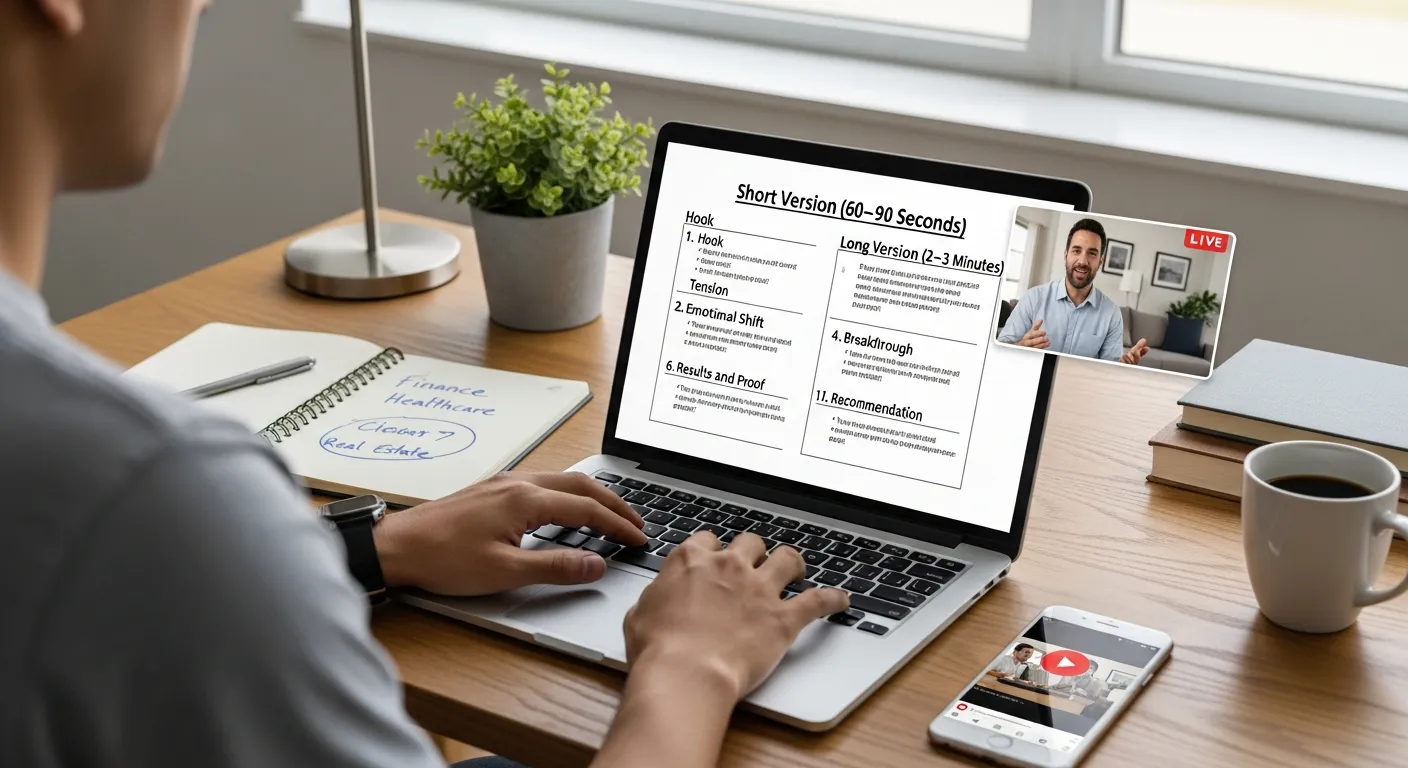
Let’s make this super plug‑and‑play for you.
Here are two ready-to-use versions of this video testimonial script template you can send straight to a client, or load into whatever tool you’re using.
You can tweak the examples for healthcare, finance, real estate, or any service business.
Short Version (~60–90 Seconds)
Perfect for: your homepage, landing pages, social media, cold email follow‑ups.
Instructions to send your client:
“Don’t overthink this. Just answer these questions like you’re talking to a friend. Aim for 1–2 sentences each.”
- Hook
- _“Before working with [Your Name/Business], what was the main problem you were dealing with?” _
2. Tension
- “How was that problem affecting your life or business?”
(Prompt if needed: time, money, stress, health, relationships.)
3. Emotional Shift
- “How did you find [Your Name/Business], and what made you decide to give them a try?”
4. Breakthrough
- “What changed after you started working together?”
(Prompt: any quick wins or aha moments.)
5. Proof
- “Can you share any specific results, numbers, time saved, or big milestones?”
6. CTA Story
- “Who would you recommend [Your Name/Business] to, and what would you tell them?”
Example (Finance, spoken):
“Before working with Lee Financial, money felt like this constant background noise in my head. I was making a good income, but I had no plan, and it showed.
It was affecting my sleep, my marriage, and every big decision felt like a fight between fear and ‘just wing it.’
I heard about David through a colleague, and honestly, I hesitated for months, but after our first session, I felt like someone finally had a map for me.
Within three months, we’d paid off two high‑interest cards and built a real emergency fund. For the first time, I knew exactly what my money was doing.
If you’re a busy professional who keeps shoving your finances to “next month,” call him now. You’ll wish you started earlier.”
That’s under 90 seconds and loaded with tension, transformation, and a built‑in CTA.
Long Version (2–3 Minutes)
Perfect for: deeper case studies, YouTube, webinar replays, or high‑ticket funnels.
Instructions to send your client:
“Answer these in your own words. It’s okay to be imperfect; small pauses and laughs make it feel real. Aim for 2–3 sentences per question.”
- Introduce yourself
“Can you share your name, what you do, and who you help?”
- The problem
“What was going on before we worked together? How long had this been an issue?”
“What had you already tried, and how did that go?”
- Finding you
“How did you first come across [Your Name/Business]?”
“What made you choose us instead of another option?”
- Initial experience
“What was the process like when we first started working together?”
“Was there a moment where you thought, ‘Okay, this might work’?”
- Results and proof
“What specific changes or results have you seen since working with us?”
“Any numbers, timelines, or specific wins you can share?”
“Did anything surprise you about the experience?”
- Recommendation
“Who would you recommend us to?”
“If someone is on the fence right now, what would you tell them?”
Example (Healthcare, condensed):
“I’m Angela, a 42‑year‑old teacher, and I came to Riverside Clinic after dealing with chronic knee pain for almost five years.
Before that, I’d tried everything: pain meds, random YouTube workout routines, and even two other clinics. I’d get a tiny bit of relief and then be right back where I started.
I found Riverside through a Facebook group for teachers, and I liked that they worked with a lot of people on their feet all day. I was skeptical because I’d already spent so much money, but after the first evaluation, I felt like someone finally understood my daily life, not just “the knee.”
Within six weeks, I went from limping up the stairs at school to walking the whole campus without thinking about it. By three months, I was back to weekend hikes with my husband, something I hadn’t done in years.
If you’re a teacher or anyone who stands all day and you’ve been told to just live with the pain, please don’t wait. Go see them. You deserve to feel normal again.”
Use these word-for-word as a starting point, or tweak the prompts to fit your niche.
Once you’ve used them a couple of times, you’ll notice how much easier it is to capture stories that help you sell without sounding salesy.
Delivery Tips: How to Record for Authenticity & Maximum Impact

You can have the best script in the world and still end up with a stiff, unusable video if the recording feels awkward.
The good news: you don’t need Hollywood. You just need a few small tweaks to collect video testimonials.
Pacing and Timing
Research and real‑world data both point to a sweet spot: keep most testimonial videos under two minutes.
That doesn’t mean you cut people off mid‑sentence, but you guide the flow.
A simple rule of thumb:
- Short version: 45–90 seconds
- Deeper story: 2–3 minutes
- Anything longer: treat as raw material and edit it down
Practical tips:
- Ask one question at a time, then pause. Let them finish.
- If they ramble, say: “That was great. Can we try that again in one or two sentences?”
- Remind them: “You’re not giving a speech, just share the headlines.”
Think of yourself as a gentle editor during the recording, not just after.
Tone & Natural Language
The biggest testimonial killer? Over‑scripting.
You’ve seen it, someone stares at the camera and says, “The Smith Group provided innovative, end‑to‑end solutions…”
No human talks like that at a backyard barbecue.
You want:
- Everyday words
- Short, real sentences
- Occasional “ums,” laughs, and pauses
How to get that:
- Tell them upfront: “Please don’t try to sound professional. Just talk to me like you usually would.”
- Avoid giving them complete sentences to repeat. Use prompts and let them phrase it.
- If they ask, “What should I say?” respond with, “Tell the story like you would to your best friend who’s in the same situation.”
If you’re recording on Zoom or a smartphone, that’s totally fine.
Focus on clear audio and a calm pace over cinematic lighting.
Emotion Capture & Authenticity
This is where your testimonial goes from “nice” to sticky.
Real emotion doesn’t come from buzzwords. It comes from specific moments.
Questions that unlock those moments:
- “Can you remember a day when this problem felt especially heavy?”
- “Was there a particular moment you realized, ‘Wow, this has really changed’?”
- “How does life feel different now?”
And then, this part’s important, be quiet.
Let them think. Let the silence stretch a few seconds. That’s usually when the real gold surfaces:
“Honestly… I don’t cry in the car on the way to work anymore.”
“My son doesn’t see me stressed out about money every night now.”
“For the first time, I feel like this business is working.”
Those small, imperfect, very human lines do more for your brand than any polished tagline.
If you use a human‑first service like Share One, they’ll coach your clients through this kind of relaxed, unscripted storytelling for you. But even if you’re DIY‑ing it, a calm conversation, open‑ended questions, and a bit of patience go a long way.
Why This “Unconventional” Script Works
On paper, this structure looks almost too simple.
But under the hood, you’re stacking a few powerful pieces of psychology.
- Social proof that feels personal, not staged.
People trust people who look and sound like them. When your client talks about missing mortgage approvals, avoiding medical bills, or panicking over retirement, your buyer thinks, “That’s literally my situation.” That’s social proof doing its best work.
- Storytelling that mirrors how your buyer decides.
We rarely make decisions from a spreadsheet alone. We remember stories: the pain, the turning point, the relief. This 6‑part flow matches that pattern: it starts in the pain, moves through the decision, and lands in the outcome.
- Balance of heart and complex numbers.
If it’s all feelings, your analytic prospects tune out. If it’s all numbers, your more emotional buyers don’t connect. By pulling in both “I slept better” and “we added 15 new clients last quarter”, you give every type of brain something to grab onto.
- Built‑in objection handling.
When your client says, “I was skeptical about the cost,” or “I’d been burned by another broker,” they’re naming the exact reasons a stranger on your site is hesitating. And then they show how they moved past it. That’s far more believable than you defending yourself.
- Easy to repeat across your whole funnel.
The same structure works for a dentist in Denver, a financial planner in Austin, and a realtor in Miami. You can have one story on your homepage, another on a service page, another in a nurture email, each one tuned to a slightly different ideal client but following the same backbone.
This is also why human‑first services like Share One lean on conversation over scripts.
You get the power of a clear script and question templatewithout losing the little quirks that make your client a real person. That combination, structure + spontaneity, is what turns “Yeah, they seem good” into “Okay, I’m booking a call.”
Turn Client Stories into Conversions with Share One
You already have the raw material for powerful marketing sitting in your calendar history and CRM, those client wins you rush past on busy Tuesdays.
A simple, human video testimonial framework turns those quiet success stories into visible proof that your next buyer can’t ignore.
You don’t need a studio, a script memorized word‑for‑word, or a Hollywood budget. The solution you need:
- A clear story arc (the six parts you just saw)
- A few thoughtful prompts
- A willingness to let your clients be delightfully imperfect on camera
If you’d rather not juggle invitations, coaching, filming, and editing on your own, a human‑first partner like Share One can take the whole thing off your plate, from “Would you mind sharing your story?” to polished clips on your website, emails, and social feeds.
Either way, the next step is small and doable: pick one happy client, send them the short script above, and ask for a quick video this week. Start there.
Let that one honest story start compounding into more leads, more trust, and more of the right people saying yes to you.
Share One’s Done-For-You Service Handles Your Video Testimonials From Script to Screen➡️
Frequently Asked Questions
What is a video testimonial script template and why does it matter?
A video testimonial script template is a simple structure of prompts you give a client so their story follows a clear arc instead of rambling. It helps capture a compelling before-and-after journey, builds emotional trust, and produces short, reusable clips that convert better than random, unstructured reviews.
How does the 6-part video testimonial script template work?
The 6-part conversion script walks your client through Hook, Tension, Emotional Shift, Breakthrough, Proof, and CTA Story. You ask open-ended questions for each stage, and they answer in their own words. This mirrors how buyers decide: feeling the pain, seeing the turning point, and believing the outcome.
How long should a video testimonial be when using this template?
Most video testimonials should stay under two minutes. Use the short script version for 45–90 second clips for homepages, landing pages, and social media, and the longer 2–3 minute version for deeper case studies, YouTube, or high-ticket funnels. Anything longer should be edited down into tighter, focused segments.
Do I need a studio or professional gear to use this video testimonial script template?
No, you don’t need a studio or fancy gear. Zoom calls or smartphone recordings are fine as long as audio is clear and pacing is calm. Focus on natural conversation, good prompts, and guiding your client to concise answers rather than chasing cinematic production quality.
Can this video testimonial script template work for B2B and SaaS companies?
Yes. The 6-part structure is industry-agnostic. For B2B or SaaS, your client still has a struggle, tried solutions, a turning point, and measurable results like time saved, reduced churn, or more revenue. You simply swap in examples and prompts that reference workflows, teams, or software outcomes instead of personal life changes.
What are the best ways to make scripted testimonials sound natural on camera?
Treat the video testimonial script template as prompts, not lines to read. Tell clients to speak like they’re talking to a friend, avoid marketing buzzwords, and use 1–2 sentence answers. Ask one question at a time, allow pauses, and, if needed, gently re-record shorter versions to keep it conversational and authentic.