Share One vs Endorsal: Which Wins Your Trust?
Share One vs Endorsal breaks down features, costs, and conversion impact to help you choose between cinematic video stories or high-volume review widgets.
If you’ve ever wondered why some sites feel instantly trustworthy while others think a little… sketchy, here’s a clue: people who watch real customer stories are more likely to become buyers than people who don’t.
In a world where 90% of folks trust other customers more than your ads, video testimonials aren’t a nice-to-have; they’re the backbone of modern social proof and a serious edge in crowded spaces like healthcare, finance, and real estate.
So if you’re choosing between Share One and Endorsal (or trying to figure out which kind of video testimonial setup makes sense for you), this guide walks you through the tradeoffs, the money math, and the real-world use cases, so you can stop guessing and start turning browsers into believers.
(For more comparisons, see how Share One stacks up across all primary testimonial tools in our Compare Video Testimonial Tools Hub →)
Key Takeaways
- In the share one vs endorsal comparison, Endorsal focuses on collecting a high volume of quick reviews and widgets, while Share One centers on premium, story-driven video testimonials.
- Share One guides clients through structured prompts and provides professional editing, creating cinematic, branded video stories that drive trust and conversions, especially for high-ticket or high-trust services.
- Endorsal is more affordable and scalable for basic social proof, making it ideal for eCommerce, early-stage businesses, and lower-value, high-volume offers needing lots of ratings and text reviews.
- For industries like healthcare, finance, and real estate, Share One’s emotionally rich, well-produced patient or client stories often deliver more substantial ROI because a single persuasive video can justify the investment.
- The most innovative approach for many service brands is a hybrid: use Endorsal-style tools for review volume, then elevate the best transformation stories into Share One-style hero videos that anchor your brand’s social proof.
Why Video Testimonials Are the New Social Proof Standard
You’ve got excellent services, a solid team, and a decent website, but strangers online still hesitate.
That’s not a “you” problem. It’s a trust problem.
Authentic video testimonials fix that by putting real faces and real voices front and center.
Instead of a bland line of text (“Great service, five stars”), your future client sees someone just like them talk about how you solved their back pain, got their mortgage approved, or helped them clean up their finances before tax season.
Why do they work so well?
When someone hits play, a lot happens at once:
- They see facial expressions, relief, excitement, and gratitude.
- They hear the tone of voice, the little quiver when someone talks about a scary diagnosis, or the laugh when they remember how stressed they were before you stepped in.
- They feel the story, not just the outcome, but the before-and-after.
That multi-sensory mix is why video-focused reviews routinely boost conversions. Industry studies line up on this: visitors who watch client stories are dramatically more likely to book a call, request a quote, or join a program.
And there’s a quiet SEO bonus.
Video keeps people on your site longer.
Search engines notice when visitors hang out instead of bouncing in 5 seconds. Longer “dwell time” is a strong signal that your content is valuable, which supports better rankings and more of the right traffic.
A few quick truths worth holding onto:
- Short wins. Around 2 minutes or less is the sweet spot.
- Imperfect is powerful. A slightly awkward smile or a dog barking in the background? Weirdly human, and way more believable than a stiff, over-scripted performance.
- Small businesses often benefit most. You’re not a faceless brand. Video lets prospects feel that.
All of this is why choosing the right platform is a big deal. You’re not just picking a tool, you’re deciding how your future clients feel when they meet your brand for the first time.
Feature-by-Feature Comparison
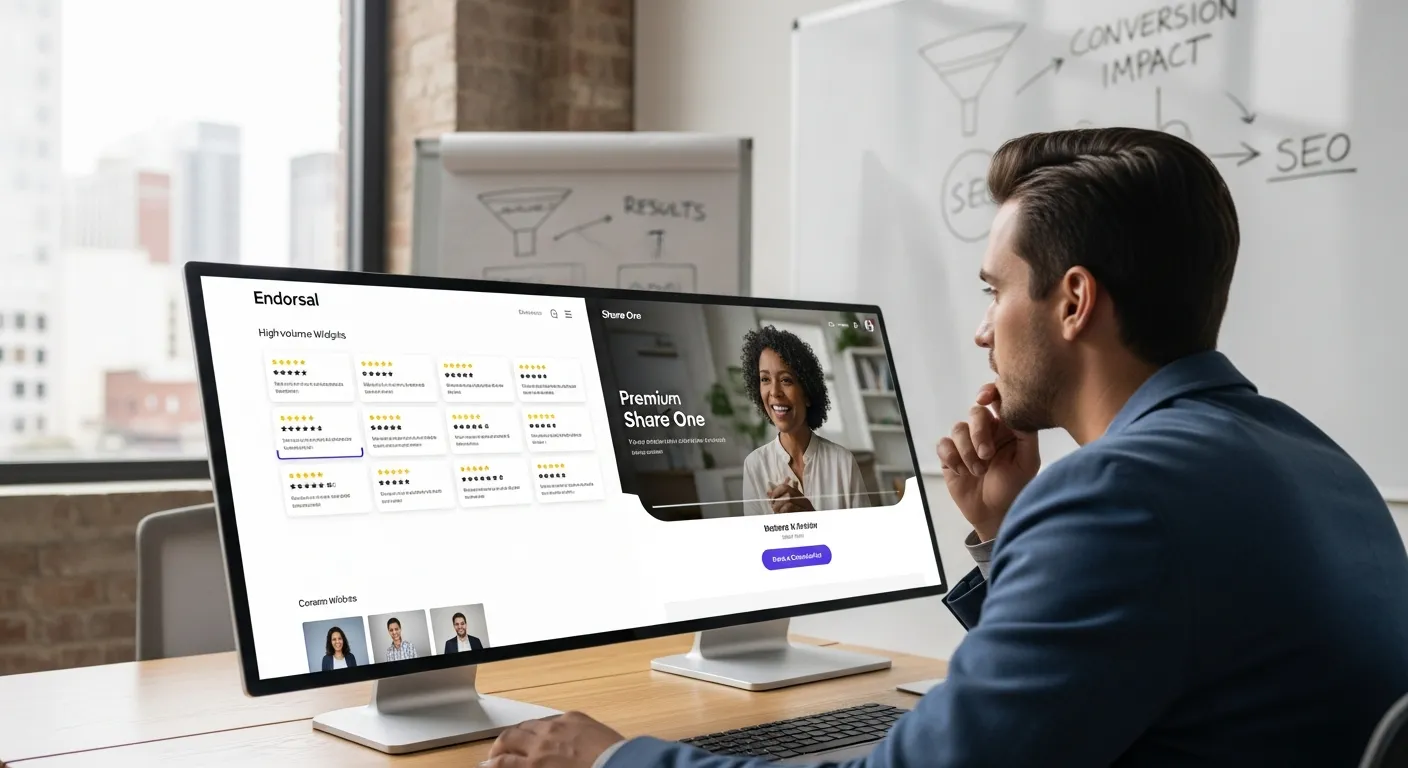
Let’s zoom in on the big question on your mind: how does Share One stack up against Endorsal?
Here’s a quick snapshot before we unpack the details:
FeatureShare OneEndorsal
Core focusStory-driven video testimonials with pro polishHigh-volume review + testimonial widgets (text + some video)
Ease of useHands-off, guided process: team does the heavy liftingDIY setup: more toggles and settings to manage
Collection methodGuided, story-based interviews and simple recording flowsForms and automated review requests (email/SMS)
EditingProfessional editing is included in full-service plansNo editing, raw clips only
Brand feelHigh-end, cinematic social proof for your brandFunctional, widget-style social proof
Analytics depthDesigned to track funnel impact per storyFocused on volume, ratings, and review counts
Best fitHigh-trust, high-value services (healthcare, finance, real estate, SaaS, agencies)Higher-volume, lower-touch offers or early-stage review collection
Now let’s break it down in plain language.
Collection Process
With Endorsal, you:
- Build a form.
- Hook it into email or SMS.
- Nudge people to leave a review.
It’s like putting out a digital comment card.
Great for volume, especially if you already have an extensive client list and need more reviews flowing in.
But the experience is mostly on autopilot. You’re hoping customers know what to say and how to say it on video without freezing up.
With Share One, the process feels more like a guided conversation than a blank form.
You get:
- Structured prompts that pull out real stories (not just “They were great.”).
- Short, focused question flows so people don’t ramble for 15 minutes.
- A done-with-you or done-for-you process, especially helpful if your clients aren’t super techy.
If you’re a busy clinic owner, broker, or advisor, that hand-holding matters. Your patients or clients don’t have time to wrestle with clunky tech either.
Presentation & Branding
Picture two websites.
On one, you see a neat little grid of reviews, stars, a name, maybe a small video thumbnail.
On the other hand, you land on a clean hero section with a bold headline, and right under it, a short, beautifully edited patient story. The colors match your brand. The lower-third title shows their name and city. The call-to-action button sits just below the video, inviting the viewer to book.
That second one? That’s the Share One approach.
Endorsal leans into widgets:
- Carousels of reviews.
- “Wall of Love” pages.
- Badges you can sprinkle around your site.
They’re helpful and lightweight, especially if you mainly care about showing how many people like you.
Share One leans into narrative:
- Fully branded video stories.
- Clips ready to use in ads, email, landing pages, and social.
- Cohesive look and feel across every story.
You’re not just displaying proof, you’re building a brand mood.
Editing, Quality & Authenticity
Endorsal doesn’t touch your footage.
Whatever your customer records are, that’s what you get.
That can be charmingly raw… or painfully long, poorly lit, and hard to hear.
Share One treats each story like a little documentary.
You still get real people, real words, real emotions, but with:
- Clean cuts and pacing.
- Better sound.
- On-brand visuals.
Here’s the key nuance: authenticity doesn’t mean sloppy.
You don’t need Hollywood-level production, but you do want:
- Clear audio (especially in healthcare or finance, where details matter).
- Tight storytelling (so you don’t lose people halfway in).
- A beginning, middle, and end.
Share One is built to hit that balance: human, unscripted, but shaped.
Analytics, SEO & Conversion Impact
If you’re the kind of person who loves dashboards (or at least wants proof this stuff is working), this part matters.
Endorsal gives you the basics:
- Rating averages.
- Number of reviews.
- Where they came from.
Useful, but fairly surface-level.
Share One goes deeper into impact.
Because each story is an asset, you care about:
- How long people watch.
- Where they drop off.
- Which stories drive more clicks or booked calls?
Combined with the natural SEO boost of having high-quality video on your site, those insights make it easier to answer big questions like:
“Which client stories are moving the needle?”
If you’re in a high-ticket space, like a $15k surgery package, a long-term wealth management relationship, or a luxury property sale, one strong video that converts can justify the entire investment in a heartbeat.
Ready to switch? Learn about the migration plan →

Pricing & ROI Comparison
Let’s talk money, because you’re not buying software, you’re buying more qualified leads and better close rates.
Endorsal usually looks cheaper on the surface.
You pay a subscription, get access to widgets and review forms, and your cost per testimonial is low if you’re mostly collecting text and a few short videos.
Perfect if your main goal is: “We just need more reviews everywhere.”
But there are tradeoffs:
- Plans often limit how many videos you can host.
- As you add more brands, locations, or websites, you may need extra accounts.
- Each raw video still needs editing if you want to use it in ads or polished campaigns, which means more tools, more time, or hiring a freelancer.
So the sticker price looks light… until you factor in your time, extra tools, or unplanned production costs.
Share One sits in that “premium but not agency-insane” space.
You’re paying for:
- A platform tuned specifically for high trust, story-driven social proof.
- Professional-level editing and guidance on specific plans.
- Reusable assets that can live on your homepage, in your funnels, in your follow-up emails, and on social.
Yes, the per-asset cost is higher than a generic widget tool.
But here’s where ROI gets interesting.
Imagine you’re a small orthopedic practice.
You add three powerful patient stories to your site and run them in warm retargeting ads.
Those stories help you close just two extra surgeries in a month.
Or you’re a mortgage broker.
You add a couple of clear, emotional stories from first-time buyers to your landing pages.
If those nudge even a small percentage of your browsers to schedule a call, the additional revenue quickly dwarfs what you spent on the stories.
This is the core difference:
- Endorsal is built for volume of proof.
- Share One is built for depth of persuasion.
If your average client value is a few hundred dollars and you live on transaction volume, a cheaper widget makes sense.
If your average client value is in the thousands or your reputation directly affects referrals, higher-quality, story-centric assets are often the better investment.
Pros & Cons: Which Tool Wins and When
Both tools exist for a reason.
They’re just solving slightly different problems.
Let’s break down the strengths and limits in a way that maps to how you run your business.
Automated Widget Tools
These platforms, Endorsal, Senja, etc, are all about automation and volume.
What you’ll probably like:
- Quick setup: forms, widgets, automatic emails.
- Affordable monthly plans, especially early on.
- Great for stacking lots of social proof across your pages.
If you sell lower-ticket items, or you’re just trying to stop being the only site without reviews, tools in this family are painless to start.
But here’s the catch.
Your average review sounds like everyone else’s:
“Great service, highly recommend.”
Kind? Yes.
Persuasive for a stranger considering a $10k procedure or a significant financial move? Not really.
You’re also limited by what your clients decide to say and how well they are on camera.
No editing.
No storytelling structure.
No help drawing out the emotional arc, the “before I found them…” part that hooks people.
Widget tools shine when:
- You need lots of proof fast.
- Brand polish isn’t your top priority.
- You’re early-stage and just want to show you’re not new or untested.
They’re less ideal when:
- You operate in high-trust fields (health, money, legal, real estate).
- You’re advertising heavily and need scroll-stopping creatives.
- You want to be remembered, not just “well-reviewed.”
Video Testimonial Services (Share One)
Share One sits firmly in the full-service camp, more like Testimonial Hero than a basic widget, but with its own spin on authentic, emotionally rich storytelling.
Where it really shines:
- Story-first approach. Your clients aren’t left to ramble. They’re guided to share specific turning points, fears, and wins.
- Production handled. Editing, trimming, pacing, and branding, the heavy lifting is done for you.
- Reusability. Each video becomes a multi-purpose asset you can slice into reels, embed on pages, or send to your email list.
For you, this means your best client stories no longer live only in your head or in a long email you screenshotted.
They live on your site, in your funnels, and inside your sales calls.
The tradeoffs:
- Higher cost per testimonial than simple widgets.
- Slightly slower process than mass text-review collection.
- Requires a bit of scheduling and participation from your clients (though Share One is set up to make that as painless as possible).
So who “wins”? It depends on the question you’re asking:
- If the question is “How do I cheaply collect lots of basic reviews?” → Endorsal and similar tools.
- If the question is “How do I turn my happiest clients into my best salespeople on camera?” → Share One takes it.
Most serious service businesses end up pairing both: widgets for quantity, Share One for the stories you build your brand around.
Use Cases: When to Use Widgets vs When to Invest in Video Testimonials
Let’s put this into real-life scenarios so you can see where you land.
When a widget tool like Endorsal makes sense
1. High-volume eCommerce or simple offers
You’re selling products under a couple of hundred bucks: supplements, skincare, online templates, home gadgets.
You want:
- Star ratings.
- Short blurbs.
- Maybe a few casual videos filmed on phones.
A widget-based platform lets you:
- Show off review volume (“1,248 happy customers”).
- Add proof to product pages and checkout.
- Keep costs predictable.
2. Early-stage credibility boost
You’re just starting to get traction.
You’ve got a handful of happy clients, but nothing formal on your website.
In this phase, getting anything on the page, stars, screenshots, and basic quotes is a big step up from silence.
Endorsal helps you collect and organize that without hiring a pro team yet.
When Share One is the better play
1. Healthcare practices
Think:
- Physical therapy clinics.
- Dental practices.
- Functional medicine or wellness centers.
Your patient isn’t just buying a service: they’re handing you their body, health, fears, and hopes.
A clean, emotional 90-second story from a real patient, talking about sleeping through the night again, or walking without pain, hits in a way no one-paragraph review can.
2. Financial services & advisory
Retirement planning, wealth management, tax strategy, mortgage brokering.
Money is personal.
Hearing someone explain how you guided them through a stressful audit, or helped them finally buy their first home, builds a level of safety they don’t get from generic “5 stars, good service” blurbs.
3. Real estate
If you’re an agent, property manager, or developer, your clients are making some of the most significant financial decisions of their lives.
Hearing a couple talk about how you navigated a nightmare bidding war for them? Or a landlord describing how you turned around their vacancy problem?
That’s story gold.
4. High-ticket offers or long-term commitments
Any time your offer involves:
- Multi-month engagements.
- High price tags.
- Deep emotional stakes.
You don’t just need people to know you’re good… You need them to feel it.
That’s where Share One’s storytelling-driven workflow really pays you back.
The hybrid sweet spot
Here’s the move I see works best:
- Use a tool like Endorsal to gather lots of quick reviews (text, stars, a few DIY videos).
- Identify the most powerful transformation stories from that pile.
- Bring those individuals into Share One’s process to create your hero videos.
Now you’ve got:
- Volume for social proof.
- Depth for persuasion.
And your site looks less like a random Yelp feed and more like a curated gallery of real transformations.
Ethics, Compliance & Authenticity Considerations
If you’re in healthcare or finance, your brain is probably whispering, “This all sounds great… but is it compliant?”
That’s the right question.
A few principles to keep you safe and sincere:
1. Get written consent, always.
Don’t rely on verbal “yeah, sure.” Spell out where and how you’ll use their video: website, ads, social, email. Store it with your records.
Share One’s workflow is designed with this in mind: explicit permission, clear expectations.
2. Don’t script people like actors.
You can guide, but avoid handing someone a word-for-word script.
It feels stiff.
You want prompts like:
- “What was life like before you found us?”
- “What were you nervous about at first?”
- “What changed after working with us?”
That way, the story is theirs, you’re just shaping the arc.
3. Avoid incentives that distort the truth.
A little thank-you gift is fine: a bribe for “only 5-star reviews” is not.
Both Share One and Endorsal can be used ethically; the responsibility is on you to frame the ask honestly.
4. Be transparent about results.
Especially in health and finance:
- Avoid implying guaranteed outcomes.
- Consider adding a short on-screen disclaimer if needed.
“Results vary. This story reflects one client’s personal experience.”
It’s simple and keeps things grounded.
5. Watch out for proof fatigue.
If your site is an endless scroll of nearly identical praise, people tune out.
Strong, differentiated stories work better than 200 copy-paste lines of “Amazing.”
That’s another subtle win for curated, well-produced stories: you can pick the ones that show different fears, different starting points, different wins.
In short: respect your clients, honor their words, and use tools that make consent, clarity, and authenticity easier, not harder.
Want more proof? Take a peek at Share One vs Storyprompt for another comparison.
Final Verdict & Recommendation
If you’ve read this far, you’re not just casually curious; you’re probably wrestling with a very real question:
“What’s the smartest way to turn my happy clients into new revenue this year?”
Here’s the cleanest way to frame it.
- Use Endorsal (and similar tools) when you need lots of reviews fast, your offer is lower-ticket, and you’re okay with raw, mostly unedited proof.
- Choose Share One when each new client is high value, trust is everything, and you want stories that feel more like mini-documentaries than random clips.
If you’re in healthcare, finance, real estate, or any advisory/service role where people hand you their health, money, or future, I’d lean hard toward Share One as your primary storytelling engine, and keep widgets as a supporting act.
The upside is simple:
- Stronger emotional connection.
- Better-qualified leads.
- Assets you can reuse for years.
If you’re curious what that could look like for your brand, don’t overthink it.
Get in touch with the Share One team, bring one client story you’re proud of, and see how it could live on screen.
Start there, one story, and let it show you how much quieter your “Do I trust this business?” objection becomes for the next person who lands on your site.
Get Started with Share One➡️
Frequently Asked Questions
What is the main difference between Share One vs Endorsal for testimonials?
The core difference in Share One vs Endorsal is depth vs volume. Share One focuses on guided, story-driven video testimonials with professional editing and branding for high-trust, high-ticket services. Endorsal emphasizes automation, review widgets, and collecting many text and basic video reviews quickly at a lower cost per review.
When should I choose Share One instead of Endorsal?
Choose Share One if you work in high-trust, high-value fields like healthcare, finance, real estate, or premium services where each client is worth thousands. You’ll benefit more from polished, emotional video stories that boost conversions, can be repurposed in ads and funnels, and are carefully edited to match your brand.
When is Endorsal a better fit than Share One?
Endorsal is ideal for high-volume, lower-ticket products or early-stage businesses that simply need more reviews on the page. It excels at automating review collection via forms, email, and SMS, then displaying them in widgets, carousels, and “Wall of Love” pages across your site without requiring heavy production work.
How do video testimonials from Share One vs Endorsal impact SEO and conversions?
Both tools can help, but in different ways. Endorsal strengthens social proof through volume and star ratings. Share One’s high-quality video stories increase dwell time, emotional engagement, and trust, which can lift conversions and send positive engagement signals to search engines, supporting better rankings and higher-quality leads over time.
Are video testimonial platforms worth it for small service businesses?
Yes, especially for small service businesses where trust drives bookings. Even a few strong video testimonials can outperform dozens of text reviews by showing real faces, emotions, and before-and-after stories. If budgets are tight, start with a widget tool, then invest in premium, story-driven videos once you see traction.